


Page 39 - PRE-U STPM CHEMISTRY TERM 1
P. 39
Chemistry Term 1  STPM

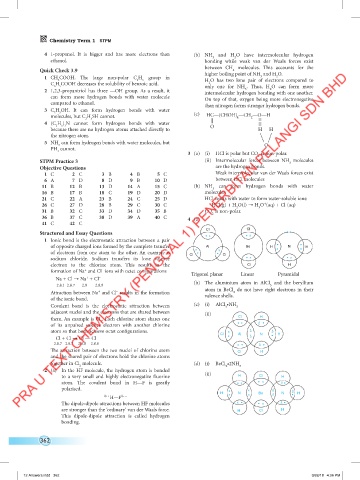
                4  1-propanol. It is bigger and has more electrons than   (b)  NH  and H O have intermolecular hydrogen
                                                                        3
                                                                               2
                  ethanol.                                           bonding while weak van der Waals forces  exist
              Quick Check 3.9                                        between CH  molecules. This accounts for the
                                                                              4
                                                                     higher boiling point of NH  and H O.
                                                                                             2
                                                                                       3
                1  CH COOH.  The  large  non-polar  C H   group in   H O has two lone pair of electrons compared to
                                                5
                    3
                                              6
                  C H COOH decreases the solubility of benzoic acid.  2
                   6  5                                              only one for NH . Thus, H O can form more
                                                                                          2
                                                                                  3
                2  1,2,3-propantriol has three —OH  group.  As  a result, it   intermolecular hydrogen bonding with one another.
                  can form more hydrogen bonds with water molecule    On top of that, oxygen being more electronegative
                  compared to ethanol.                               than nitrogen forms stronger hydrogen bonds.
                3  C H OH.  It  can  form  hydrogen  bonds  with  water   (c)
                   2
                     5
                  molecules, but C H SH cannot.                      HC—(CHOH) —CH —O—H
                                                                                4
                                                                                    2
                             2  5                                      ||
                4  (C H ) N cannot form hydrogen bonds with water      O
                     5 3
                    2
                  because there are no hydrogen atoms attached directly to             H      H
                  the nitrogen atom.
                5  NH  can form hydrogen bonds with water molecules, but                 O
                    3
                  PH  cannot.
                    3
                                                                3  (a)  (i)  HCl is polar but CO  is non-polar.
                                                                                       2
              STPM Practice 3                                        (ii)  Intermolecular forces between NH  molecules
                                                                                                 3
              Objective Questions                                       are the hydrogen bonds.
                1  C     2  C      3  B     4  B     5  C               Weak intermolecular van der Waals forces exist
                6  A     7  D      8  D     9  B    10  D               between HCl molecules
                11  B   12  B     13  D    14  A    15  C        (b)  NH   can form  hydrogen  bonds  with  water
                                                                        3
                16  B   17  B     18  C    19  D    20  D            molecules.
                21  C   22  A     23  B    24  C    25  D            HCl reacts with water to form water-soluble ions:
                                                                                         +
                26  C   27  D     28  B    29  C    30  C              HCl(g) + H O(l) → H O (aq) + Cl (aq)
                                                                                                –
                                                                                       3
                                                                               2
                31  B   32  C     33  D    34  D    35  B            CO  is non-polar.
                                                                       2
                36  B   37  C     38  D    39  A    40  C       4  (a)
                41  C   42  C
              Structured and Essay Questions                         Cl            Cl           x x
                                                                      x •           x •
                1  Ionic bond is the electrostatic attraction between a pair
                  of opposite charged ions formed by the complete transfer   Al   Be       H  • x  N  • x  H
                  of electrons from one atom to the other. An example is    Cl  • x  • x  Cl
                  sodium chloride. Sodium transfers its lone valence                x •          x •
                  electron to the chlorine atom. This results in the               Cl            H
                                   –
                             +
                  formation of Na  and Cl  ions with octet configurations     Trigonal planar   Linear   Pyramidal
                    Na + Cl → Na  + Cl –
                              +
                          2.8.1  2.8.7      2.8       2.8.8      (b)  The aluminium atom in AlCl  and the beryllium
                                                                                          3
                                                                     atom in BeCl  do not have eight electrons in their
                                        –
                                  +
                  Attraction between Na  and Cl  results in the formation   valence shells. 2
                  of the ionic bond.
                  Covalent  bond  is  the  electrostatic  attraction  between    (c)  (i)  AlCl •NH 3
                                                                            3
                  adjacent nuclei and the electrons that are shared between
                                                                     (ii)
                  them. An example is Cl . Each chlorine atom shares one        Cl     H
                                  2
                  of its unpaired valence electron with another chlorine         x •    •
                  atom so that both achieve octet configurations.            x
                    Cl + Cl → Cl — Cl                                     Cl  •  Al    N   •  H
                          2.8.7   2.8.7    2.8.8    2.8.8                       x •     •
                  The attraction between the two nuclei of chlorine atom        Cl     H
                  and the shared pair of electrons hold the chlorine atoms
                  together in Cl  molecule.                      (d)  (i)  BeCl •2NH
                           2                                                2   3
                2  (a)  In  the  HF  molecule,  the  hydrogen  atom  is  bonded
                     to a very small and highly electronegative fluorine   (ii)   H    Cl     H
                     atom. The covalent bond in H—F is greatly                   x •   • x     •
                     polarised.                                                    x
                                                                          H  •  N      Be     N     H
                                    δ  ++ H—F δ––                            x     x              •
                     The dipole-dipole attractions between HF molecules         x •    • x     •
                     are stronger than the ‘ordinary’ van der Waals force.      H      Cl     H
                     This dipole-dipole attraction is called hydrogen
                     bonding.
              362
         12 Answers.indd   362                                                                          3/26/18   4:06 PM

