Page 43 - PRE-U STPM CHEMISTRY TERM 1
P. 43
Chemistry Term 1  STPM

                5  (a)  60                                       (b)  (i)  Volume of one argon atom
                  (b)  119.9                                              4  3
                  (c)  88.3%                                             =  3  πr
                                                                          4
              STPM Practice 4                                            =  π (0.192  10 )  m 3
                                                                                     –9 3
              Objective Questions                                         3      –29  3
                1  B     2  C      3  C     4  D     5  B                = 2.96  10  m
                6  D     7  D      8  B     9  D    10  B                Volume of one mole of argon atom
                                                                                           23
                                                                                  –29
                11  B   12  D     13  D    14  C    15  C                = (2.96  10 )(6.02  10 )
                                                                                 –5
                16  C   17  B     18  D    19  C    20  A                = 1.78  10  m 3
                21  A   22  A     23  B    24  D    25  B            (ii)  PV = nRT
                26  B   27  B                                            (101  10 )V = 1  8.31  273
                                                                                3
                                                                                           –2
              Structured and Essay Questions                                     V = 2.25  10  m 3
                1  (a)  A gas that obeys the gas law:  PV =  nRT under all    (iii)  % =    1.78 × 10 –5
                                                                                   –2   100% = 0.079%
                                                                             2.25 × 10
                     conditions
                  (b)  (i)  When temperature increases, the kinetic energy   (iv)  The volume of the gas molecules is indeed
                         of the particles increases. This leads to an    negligible when compared to the volume
                         increase in the rate of collision with the walls of   occupied by the gas.
                         the container. At the same time, the collisions     5  (a)  Increasing pressure pushes the gas particles closer
                         are more energetic.                         to one another. The attractive force is then strong
                     (ii)  Increasing pressure pushes the molecules closer   enough to hold the particles together causing it to
                         to one another. This reduces the amount of   condense.
                         empty space between the particles causing the   (b)  Presence of intermolecular hydrogen bonding pulls
                         volume to decrease.                         the molecules closer.
                     (iii)  When temperature increases, the pressure   (c)  There are no intermolecular forces between gas
                         exerted by the gas will increase. To maintain the   particles. They are free to move around and thus will
                         original pressure, the volume occupied by the   distribute themselves throughout the container.
                         gas must increase so as to reduce the rate of     (d)  Going down the group, the size of the molecules gets
                         collision.                                  bigger and the strength of the intermolecular forces
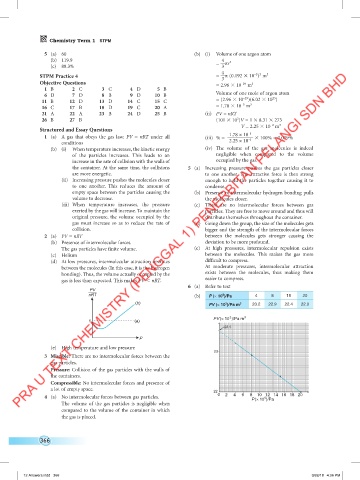
                2  (a)  PV = nRT                                     between the molecules gets stronger causing the
                  (b)  Presence of intermolecular forces.            deviation to be more profound.
                     The gas particles have finite volume.       (e)  At high pressures, intermolecular repulsion exists
                  (c)  Helium                                        between the molecules. This makes the gas more
                  (d)  At low pressures, intermolecular attraction operates   difficult to compress.
                     between the molecules (In this case, it is the hydrogen         At moderate pressures, intermolecular attraction
                     bonding). Thus, the volume actually occupied by the   exists between the  molecules,  thus making  them
                     gas is less than expected. This makes PV  nRT.  easier to compress.
                                                                6  (a)  Refer to text
                               PV
                              nRT                                (b)  P (× 10 )/Pa    4    8    15   20
                                                                           5
                                              (b)
                                                                            2
                                                                      PV (× 10 )/Pa m 3  23.2  22.9  22.4  22.0
                                                                             2
                                                                        PV (× 10  )/Pa m 3
                              1               (a)
                                                                           23.5
                                               P
                  (e)  High temperature and low pressure
                                                                        23
                3  Miscible: There are no intermolecular forces between the
                  gas particles.
                   Pressure: Collision of the gas particles with the walls of
                  the containers.
                   Compressible: No intermolecular forces and presence of
                  a lot of empty space.
                                                                        22
                4  (a)  No intermolecular forces between gas particles.  0  2  4  6  8  10 12 14 16 18 20
                                                                                         5
                                                                                    P(× 10 )/Pa
                     The volume of the gas particles is negligible when
                     compared to the volume of the container in which
                     the gas is placed.

              366


         12 Answers.indd   366                                                                          3/26/18   4:06 PM
   38   39   40   41   42   43   44   45   46   47   48