


Page 13 - Focus SPM KSSM Tg 4.5 - Add Maths
P. 13
Additional Mathematics SPM Chapter 2 Quadratic Functions
Try This! 2.1 10. Given one of the roots of the quadratic equation
8x + 2x – m = 0 is twice the other root. Find the
2
1. Solve each of the following quadratic equations by possible values of m.
using the completing the square method. 11. One of the roots of the quadratic equation
(a) x – x = 3 (b) x + x – 4 = 0 3x + hx = 6x – 25 is one third the other root. Find
2
2
2
(c) x + 5x + 2 = 0 (d) x(x – 2) = 6 the possible values of h.
2
(e) x(x + 2) – 3 = 0 (f) 2x + 3x – 2 = 0
2
(g) 3x + 6x – 1 = 0 (h) 4x – 3x – 2 = 0 12. Given the quadratic equation qx – 12x + 8 = 0,
2
2
2
q ≠ 0, has two equal roots. Find the possible values
2. Solve each of the following quadratic equations by of q.
using the formula.
(a) x + 4x – 3 = 0 (b) 2x = 3x + 4 13. Given α and b are the roots of the quadratic equation
2
2
2
2
(c) 3x + 7x – 5 = 0 (d) 4x – 5x = 2 5x – 6x + h = 0, whereas α and b are the roots
2
(e) 3x(x + 3) = 4 k k
2
of the quadratic equation 2x + 3x – 5 = 0. Find the
3. The sum of the squares for two consecutive positive values of h and k.
Form 4
integers is 2 521. Find the values of the two integers.
14. Given the quadratic equation x – (p – 10)x + 5q = 0
2
4. Given two squares with side lengths of x cm and has roots 6 and 10. Find the values of p and q.
(x – 2) cm respectively. The total area of the two
squares is 340 cm . Find the total perimeter for both 15. Given q and 4 are the roots of the quadratic equation
2
2
squares. (2x – h) = 4x. Find the possible values of h and q.
5. Nesa’s age is four times her son’s age in this year. 16. The roots of the quadratic equation (x + 1)(x – 5) =
The product of Nesa’s age and her son’s age two p(q – x) – 9 are 2 and – 6. Find the possible values
years later will be 270. Find Nesa’s age and her of p and q.
son’s age in this year. 17. Given –3 and (k – 2) are the roots of the quadratic
2
6. The product of two consecutive odd integers is equation x + (h – 5)x – 12 = 0, where h and k are
1 763. Find the values of these two integers. constants. Find the values of h and k.
18. Find the range of values of x that satisfy the following
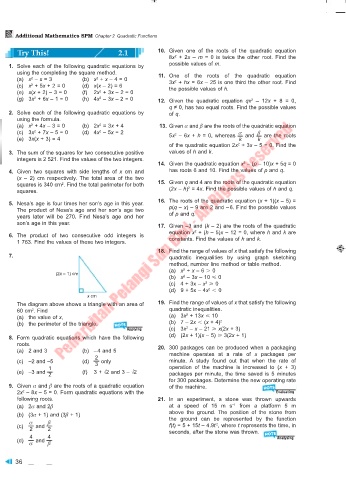
7. quadratic inequalities by using graph sketching
method, number line method or table method.
(a) x + x – 6 . 0
2
(2x – 1) cm
(b) x – 3x – 10 < 0
2
(c) 4 + 3x – x > 0
2
(d) 9 + 5x – 4x 0
2
x cm
The diagram above shows a triangle with an area of 19. Find the range of values of x that satisfy the following
2
60 cm . Find quadratic inequalities.
2
(a) the value of x, (a) 3x + 13x < 10
(b) the perimeter of the triangle. HOTS (b) 7 – 2x (x + 4) 2
2
Applying (c) 3x – x – 21 > x(2x + 3)
8. Form quadratic equations which have the following (d) (2x + 1)(x – 5) > 3(2x + 1)
roots. 20. 300 packages can be produced when a packaging
(a) 2 and 3 (b) – 4 and 5 machine operates at a rate of x packages per
2
(c) –2 and –5 (d) 3 only minute. A study found out that when the rate of
1 operation of the machine is increased to (x + 3)
(e) –3 and 2 (f) 3 + 2 and 3 – 2 packages per minute, the time saved is 5 minutes
for 300 packages. Determine the new operating rate
9. Given α and b are the roots of a quadratic equation of the machine. HOTS
2x – 8x – 5 = 0. Form quadratic equations with the Evaluating
2
following roots. 21. In an experiment, a stone was thrown upwards
–1
(a) 2α and 2b at a speed of 15 m s from a platform 5 m
(b) (3α + 1) and (3b + 1) above the ground. The position of the stone from
the ground can be represented by the function
α b 2
(c) and f(t) = 5 + 15t – 4.9t , where t represents the time, in
2 2 seconds, after the stone was thrown.
4 4 HOTS
(d) and Analysing
α b
36

