Page 16 - Focus SPM KSSM Tg 4.5 - Add Maths
P. 16
Additional Mathematics SPM  Chapter 2  Quadratic Functions

         (e)  2x(4x – 3) = 5   (f)  7x = 5x  + 3      5.  Given  the  quadratic  equation  mx   –  5nx  +  m  =  0
                                      2
                                                                                  2
         (g)  2(5x – 9) = 3x    (h)  (x + 2)(3x + 1) = x – 1   has  two  equal  roots.  Find  the  relation  between  m
                       2
                                                        and n.
       2.  Find the range of values of p if each of the following
                                                                                 2
         quadratic equations has two different real roots.    6.  Given the quadratic equation p(x  + 4) = 8qx has two
         (a)  x  – 6x + 4p = 0   (b)  2px  + 5(x – 1) = 0  equal roots. Find the ratio of p : q. Hence, find the
             2
                                   2
         (c)  x(3x + 7) = – 6 – p   (d)   x(9x + 1) = p(6x – p)  roots.
                                                      7.  If the ratio of h : k = 3 : 2, determine the types of
       3.  Find the value of k if each of the following quadratic   roots of the quadratic equation 9kx  + k = 4hx.
                                                                                   2
         equations has two equal real roots.
         (a)  3x  – 2kx + k = 0                       8.  Given that 5 and – 4 are the roots of the quadratic
              2
         (b)  kx  – 4x + 3k = 4                         equation px  – 2x + q = 0. Find
                                                                 2
              2
         (c)   4kx  = x(3k – x) – 1                     (a)  the value of p and the value of q,
               2
         (d)  x(4x – k) = k – 2(x + 1)                  (b)  the  value  of  m  where  the  quadratic  equation
                                                            px  – 2x + q = m has two equal roots.    Form 4
                                                             2
       4.  Find the range of values of h if each of the following
         quadratic equations has no roots.
         (a)  x  – 2x + 5h = 0   (b)  x  + 2hx + (2 – h)  = 0
                                             2
                                 2
             2
         (c)  5 – 2x = (3 – h)x    (d)  4x  – 4hx + h  = 5x
                         2
                                           2
                                  2
      2.3   Quadratic Functions
       A    Analysing the effects of the changes of a, b and c towards the shape and position of the
           graph of f(x) = ax  + bx + c
                            2
                                a . 0                                    a  0
                               f(x)                                    f(x)
                                   a = 1
                                a > 1                                           x
                                                                        0
                                     0 < a < 1
                                                                             0 <  a  < 1
                                        x                                a  > 1
      Only the                 0                                            a = –1
        value
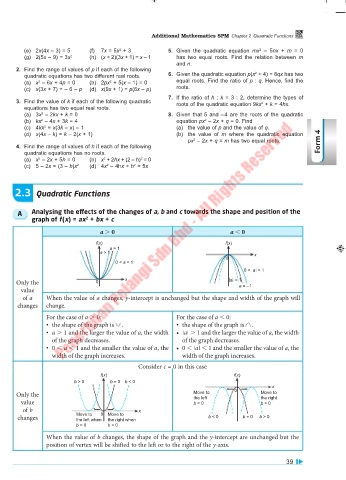
        of a   When the value of a changes, y-intercept is unchanged but the shape and width of the graph will
      changes  change.
               For the case of a . 0:                   For the case of a  0:
               •  the shape of the graph is   .         •  the shape of the graph is   .
               •  a . 1 and the larger the value of a, the width  •  a . 1 and the larger the value of a, the width
                 of the graph decreases.                  of the graph decreases.
               •  0  a  1 and the smaller the value of a, the  •  0  a  1 and the smaller the value of a, the
                 width of the graph increases.            width of the graph increases.
                                            Consider c = 0 in this case
                                f(x)                                      f(x)
                        b > 0      b = 0  b < 0
                                                                                      x
      Only the                                               Move to      0       Move to
                                                             the left
                                                                                  the right
        value                                                b < 0                b > 0
        of b                                x
      changes            Move to  0  Move to                      b < 0      b = 0  b > 0
                                   the right when
                         the left when
                         b > 0     b < 0
               When the value of b changes, the shape of the graph and the y-intercept are unchanged but the
               position of vertex will be shifted to the left or to the right of the y-axis.

                                                                                          39
   11   12   13   14   15   16   17   18   19   20   21