


Page 8 - Focus SPM KSSM F4 2020 - Chemistry
P. 8
Chemistry Form 4  Chapter 3 The Mole Concept, Chemical Formula and Equation
       3.  Using the knowledge about relative mass, we   Q2  The mass of a sulphur atom is 8 times more than
          can  solve  various  calculation  problems.  See   the mass of a helium atom. What is the relative
          Example 3.3.                                    atomic mass of sulphur?
                                                          [Relative atomic mass: He, 4]
      EXAMPLE  3.3                                    Q3  Calculate  the  relative  molecular  mass  of  the
                                                          following substances:
       The  relative  formula  mass  of  X SO   is  142.   (a)  Phosphorus, P 4
                                    2
                                       4
       Calculate the relative atomic mass of element X.   (b)  Carbon monoxide gas, CO
       [Relative atomic mass: O, 16; S, 32]               (c)  Sucrose, C H O 11
                                                                      12
                                                                        22
                                                          (d)  Benzoic acid, C H COOH
                                                                         6
                                                                           5
       Solution                                              [Relative atomic mass: H, 1; C, 12; O, 16; P,
       RAM of X = x                                          31]
       Given RFM of X SO     = 142                    Q4  Calculate  the  relative  formula  mass  of  the
                      2
                         4
                2(x) + 32 + 4(16)  = 142                  following substances:
                            2x  +  96 = 142               (a)  Sodium oxide, Na O
                                                                           2
                                     2x  = 142 – 96 = 46  (b)  Zinc nitrate, Zn(NO )
                                                                            3 2
                                      x  =   46   = 23    (c)  Potassium thiosulphate, K S O 3
                                                                                 2
                                                                                   2
                                2
  Chapter
                                                          (d)  Hydrated sodium carbonate, Na CO .10H O
 3     RAM of X is 23.                                       [Relative atomic mass: H,1; C,12; N,14; O,
                                                                                            2
                                                                                        3
                                                                                     2
                                                             16; Na, 23; S, 32; K, 39; Zn, 65]
           Checkpoint                   3.1           Q5  Element Z forms a chloride salt with the formula
                                                          ZCI  and relative formula mass of 95. What is
                                                             2
       Q1  How many oxygen atoms have the same mass       the relative atomic mass of element Z?
           as three copper atoms?                         [Relative atomic mass: Cl, 35.5]
           [Relative atomic mass: C, 12; Cu, 64]
      3.2    Mole Concept
       1.  Chemists use the ‘mole’ unit to represent the quantity of a substance.
           One mole of substance is
           defined as the quantity of
           substance containing the
           same number of atoms                                  Avogadro’s constant, N  is defined
           contained in 12 g of                                  as the number of particles.
                                                                                    A
           carbon-12, which is 6.02 ×                            (N  = 6.02 × 10 mol )
                                                                                 -1
                                                                             23
           10  particles                                           A
             23
       2.  The  number  of  particles  per  mole,  which  is  6.02  ×  10   is  determined  experimentally  and  is  known  as
                                                       23
          Avogadro’s constant or Avogadro’s number.
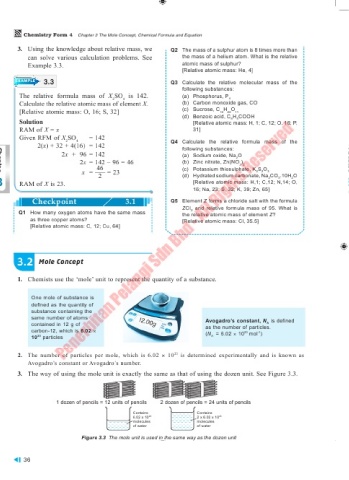
       3.  The way of using the mole unit is exactly the same as that of using the dozen unit. See Figure 3.3.


                   1 dozen of pencils = 12 units of pencils        2 dozen of pencils = 24 units of pencils

                                           Contains            Contains
                                           6.02 x 10 23        2 x 6.02 x 10 23
                                           molecules           molecules
                                           of water            of water

                           Figure 3.3  The mole unit is used in the same way as the dozen unit


        36


 03 SPM CHEMISTRY F4.indd   36                                                               27/02/2020   11:23 AM

