


Page 13 - Focus SPM KSSM F4 2020 - Chemistry
P. 13
Chemistry Form 4  Chapter 3 The Mole Concept, Chemical Formula and Equation
                                                         SPM    Highlights
        EXAMPLE 3.13
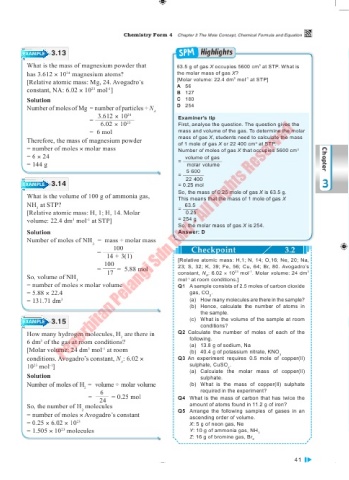
         What is the mass of magnesium powder that      63.5 g of gas X occupies 5600 cm  at STP. What is
                                                                                  3
         has 3.612 × 10  magnesium atoms?               the molar mass of gas X?
                      24
                                                                              -1
                                                                          3
         [Relative atomic mass: Mg, 24. Avogadro’s      [Molar volume: 22.4 dm  mol  at STP]

                                                        A  56

         constant, NA: 6.02 × 10  mol ]                 B  127
                                   -1
                              23
         Solution                                       C  180
         Number of moles of Mg  = number of particles ÷ N A  D  254
                                3.612 × 10 24            Examiner’s tip
                             =
                                 6.02 × 10 23            First, analyse the question. The question gives the
                             =  6 mol                    mass and volume of the gas. To determine the molar
         Therefore, the mass of magnesium powder         mass of gas X, students need to calculate the mass
                                                                                 3
                                                         of 1 mole of gas X or 22 400 cm  at STP.
         = number of moles × molar mass                  Number of moles of gas X that occupies 5600 cm 3
         = 6 × 24                                          volume of gas
         = 144 g                                         =    molar volume                            Chapter
                                                           5 600
                                                         =
                                                            22 400
        EXAMPLE 3.14                                     = 0.25 mol                                   3
                                                         So, the mass of 0.25 mole of gas X is 63.5 g.
         What is the volume of 100 g of ammonia gas,     This means that the mass of 1 mole of gas X
         NH  at STP?                                       63.5
            3
         [Relative atomic mass: H, 1; H, 14. Molar       =    0.25
         volume: 22.4 dm  mol  at STP]                   = 254 g
                            -1
                        3
                                                         So, the molar mass of gas X is 254.
         Solution                                        Answer: D
         Number of moles of NH   =  mass ÷ molar mass
                              3     100
                               =                             Checkpoint                   3.2
                                   14 + 3(1)             [Relative atomic mass: H,1; N, 14; O,16; Ne, 20; Na,
                                  100                    23; S, 32; K, 39; Fe, 56; Cu, 64; Br, 80. Avogadro’s
                               =      17   =  5.88 mol   constant, N : 6.02 × 10  mol . Molar volume: 24 dm
                                                                                                 3
                                                                               -1
                                                                          23
         So, volume of NH                                mol  at room conditions.]
                                                                 A
                                                           -1
                         3
         = number of moles × molar volume                Q1   A sample consists of 2.5 moles of carbon dioxide
         = 5.88 × 22.4                                      gas, CO .
                                                                  2
         = 131.71 dm                                        (a)   How many molecules are there in the sample?
                    3
                                                            (b)   Hence,  calculate  the  number  of  atoms  in
                                                                the sample.
                                                            (c)   What is the volume of the sample at room
        EXAMPLE 3.15
                                                                conditions?
         How many hydrogen molecules, H  are there in    Q2  Calculate  the  number  of  moles  of  each  of  the
                                       2
         6 dm  of the gas at room conditions?               following.
              3
                                                            (a)   13.8 g of sodium, Na
         [Molar volume: 24 dm  mol  at room                 (b)   40.4 g of potassium nitrate, KNO
                                 -1
                             3
                                                                                        3
         conditions. Avogadro’s constant, N : 6.02 ×     Q3  An  experiment  requires  0.5  mole  of  copper(II)
                                       A
                 -1
            23
         10  mol ]                                          sulphate, CuSO .
                                                                        4
                                                            (a)  Calculate  the  molar  mass  of  copper(II)
         Solution                                               sulphate.
         Number of moles of H  =  volume ÷ molar volume     (b)   What  is  the  mass  of  copper(II)  sulphate
                           2    6                               required in the experiment?
                             =     24    = 0.25 mol      Q4   What is the mass of carbon that has twice the
                                                            amount of atoms found in 11.2 g of iron?
         So, the number of H  molecules                  Q5   Arrange  the  following  samples  of  gases  in  an
                           2
         = number of moles × Avogadro’s constant            ascending order of volume.
         = 0.25 × 6.02 × 10 23                              X: 5 g of neon gas, Ne
         = 1.505 × 10  molecules                            Y: 10 g of ammonia gas, NH 3
                    23
                                                            Z: 16 g of bromine gas, Br
                                                                                2
                                                                                             41
 03 SPM CHEMISTRY F4.indd   41                                                               27/02/2020   11:23 AM

