


Page 56 - APS(2022)_TG5 _Edisi Guru
P. 56
Sains  Tingkatan 5  Bab 2
                                                                                        Tarikh:

                 EKSPERIMEN               Menganggarkan Nilai Kalori dalam Sampel Makanan
                    Wajib       2.4       To Estimate the Calorific Value in Food Sample
                                                                                                 Pendekatan inkuiri
                                                                                                         PEKA
          Tujuan        Menganggarkan nilai kalori bagi beberapa sampel makanan.
          Aim           To estimate the calorific value for several food samples.                         K1P1

          Pernyataan      Sampel makanan manakah yang mempunyai nilai kalori yang lebih tinggi?
    BAB
          Masalah       Which food sample has a higher calorific value?
          Problem Statement
    2
          Hipotesis     Kacang gajus mempunyai nilai kalori yang   lebih tinggi   berbanding dengan roti putih dan
          Hypothesis    ikan kering.
                        Cashew nut contains a   higher   calorific value compared to the white bread and dried fish.   K1P2

                                              Jenis sampel makanan
          Pemboleh Ubah    (a)  Dimanipulasikan :
          Variables                           Types of food samples
                            Manipulated
              K1
              PI        (b)  Bergerak balas   :   Nilai kalori sampel makanan
           1                Responding        Calorific value of food sample
    EKSPERIMEN WAJIB
           2
           3                                  Jisim air
                        (c)  Dimalarkan     :
           4
           5                Constant          Mass of water                                               K1P3
           S

          Bahan         Sampel makanan (kacang gajus segar, roti putih, ikan kering), air suling, mancis
          Materials     Food samples (fresh cashew nut, white bread, dried fish), distilled water, match

          Radas         Tabung  didih, termometer, pin panjang,  plastisin, kaki  retort  dengan pengapit,  penimbang
          Apparatus     elektronik, penghadang, silinder penyukat, penunu Bunsen
                        Boiling tube, thermometer, long pin, plasticine, retort stand with clamp, electronic balance, wind shield, measuring
                        cylinder and Bunsen burner                                                        K1P4

          Prosedur       1.  Timbang  sebiji kacang  gajus segar menggunakan  penimbang  elektronik dan rekodkan
          Procedure         jisimnya.
                            Weigh one fresh cashew nut using an electronic balance and record the mass.
              K2
              PI         2.  Isi satu tabung didih dengan 20 ml air suling.
           1                Fill one boiling tube with 20 ml of distilled water.
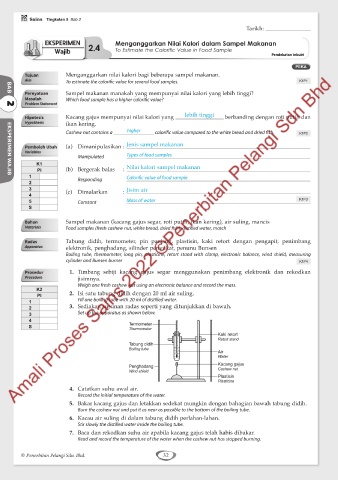
           2             3.  Sediakan susunan radas seperti yang ditunjukkan di bawah.
           3                Set up the apparatus as shown below.
           4
           S                                  Termometer
                                              Thermometer
                                                                              Kaki retort
                                                                              Retort stand
                                              Tabung didih
                                              Boiling tube
                                                                              Air
                                                                              Water
                                              Penghadang                      Kacang gajus
                                              Wind shield                     Cashew nut
                                                                              Plastisin
                                                                              Plasticine
                         4.  Catatkan suhu awal air.
                            Record the initial temperature of the water.
                         5.  Bakar kacang gajus dan letakkan sedekat mungkin dengan bahagian bawah tabung didih.
                            Burn the cashew nut and put it as near as possible to the bottom of the boiling tube.
                         6.  Kacau air suling di dalam tabung didih perlahan-lahan.
                            Stir slowly the distilled water inside the boiling tube.
                         7.  Baca dan rekodkan suhu air apabila kacang gajus telah habis dibakar.
                            Read and record the temperature of the water when the cashew nut has stopped burning.

        © Penerbitan Pelangi Sdn. Bhd.                    32


   02 BAB 2.indd   32                                                                                         7/28/21   3:01 PM

