


Page 4 - PRE-U STPM MATHEMATICS (T) TERM 2
P. 4
Mathematics Term 2 STPM Chapter 2 Differentiation
2.1 Derivatives
Feynman's
Differentiation Differentiation
Derivative of a function INFO VIDEO
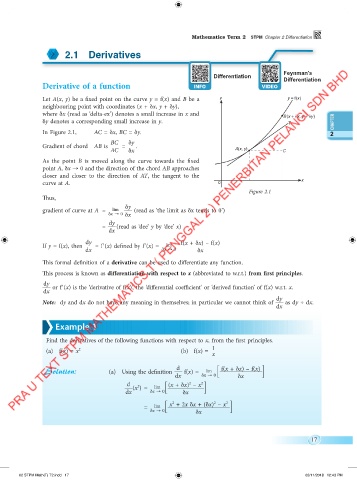
Let A(x, y) be a fixed point on the curve y = f(x) and B be a y y = f(x)
neighbouring point with coordinates (x + x, y + y),
where x (read as ‘delta-ex’) denotes a small increase in x and B(x + δx, y + δy)
y denotes a corresponding small increase in y. T
In Figure 2.1, AC = x, BC = y. 2
BC y
Gradient of chord AB is = .
AC x A(x, y) C
As the point B is moved along the curve towards the fixed
point A, x → 0 and the direction of the chord AB approaches
closer and closer to the direction of AT, the tangent to the
curve at A. 0 x
Figure 2.1
Thus,
y
gradient of curve at A = lim (read as ‘the limit as x tends to 0’)
x → 0 x
dy
= (read as ‘dee’ y by ‘dee’ x)
dx
dy f(x + x) – f(x)
If y = f(x), then = f(x) defined by f(x) = lim
dx δx → 0 x
This formal definition of a derivative can be used to differentiate any function.
This process is known as differentiation with respect to x (abbreviated to w.r.t.) from first principles.
dy or f(x) is the ‘derivative of f(x)’, the ‘differential coefficient’ or ‘derived function’ of f(x) w.r.t. x.
dx
dy
Note: dy and dx do not have any meaning in themselves; in particular we cannot think of as dy ÷ dx.
dx
Example 1
Find the derivatives of the following functions with respect to x, from the first principles.
2
(a) f(x) = x (b) f(x) = 1
x
d f(x + x) – f(x)
Solution: (a) Using the definition f(x) = lim 4
dx x → 0 x
d 2 lim (x + x) – x 2 4
2
dx (x ) = x → 0 x
2
2
= lim x + 2x x + (x) – x 2 4
x → 0 x
17
02 STPM Math(T) T2.indd 17 02/11/2018 12:43 PM

