


Page 15 - Cambridge IGCSE Mathematics Core and Extended
P. 15
Test Yourself  11.3

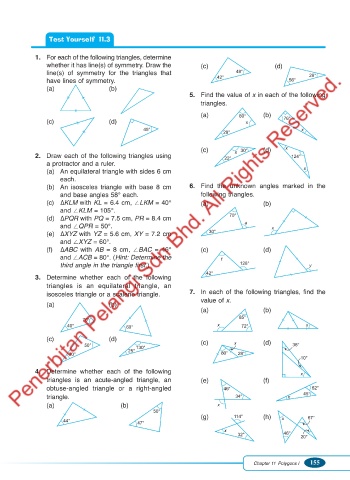
             1.  For each of the following triangles, determine
               whether it has line(s) of symmetry. Draw the    (c)                    (d)

               line(s)  of symmetry for the triangles  that               48°                   28°
                                                                    42°
               have lines of symmetry.                                                    56°
               (a)                 (b)
                                                            5.  Find the value of x in each of the following
                                                               triangles.

                                                               (a)         80°    (b)     76°
               (c)                 (d)                                       x
                                             45°                                              x
                                                                      28°

                                                               (c)       x  30°    (d)     x
             2.  Draw each of the following triangles using           22°                  124°
               a protractor and a ruler.
                                                                                              x
               (a)  An equilateral triangle with sides 6 cm
                    each.
               (b)  An isosceles triangle  with base 8 cm     6.  Find the unknown  angles  marked in the
                    and base angles 58° each.                  following triangles.
               (c)  ∆KLM with KL = 6.4 cm, /LKM = 40°          (a)                (b)
                    and /KLM = 105°.
                                                                        70°
               (d)  ∆PQR with PQ = 7.5 cm, PR = 8.4 cm
                                                                            a
                    and /QPR = 50°.                                                  x
                                                                 30°
               (e)  ∆XYZ with YZ = 5.6 cm, XY = 7.2 cm
                    and /XYZ = 60°.
               (f)  ∆ABC with  AB = 8 cm,  /BAC = 46°          (c)                (d)
                    and /ACB = 80°. (Hint: Determine the             t
                    third angle in the triangle first.)                    128°                 y
                                                                42°
             3.  Determine  whether  each of the following
               triangles  is  an  equilateral  triangle, an
                                                            7.  In  each  of  the  following  triangles,  find  the
               isosceles triangle or a scalene triangle.
                                                               value of x.
                 (a)               (b)
                                                               (a)                (b)
                                                                           65°
                          70°
                      40°               60°                         x      72°                 x
               (c)                 (d)

                           50°             130°                (c)       x        (d)       38°
                                        25°                          80°
                      30°                                                 28°
                                                                                              10°
             4.  Determine  whether  each of the following                                   x
               triangles  is  an  acute-angled triangle,  an   (e)                (f)
               obtuse-angled triangle or a right-angled               46°                        62°
               triangle.                                                 34°             x    45°
               (a)                    (b)                           x
                                                50°
                                                               (g)       114°     (h)    x      67°
                    44°
                                           47°
                                                                      x                 46°
                                                                          32°                 20°


                                                                               Chapter 11  Polygons I   155


                                                                                                14/07/2022   10:15 AM
   DA1501_pg 147 to 161.indd   155                                                              14/07/2022   10:15 AM
   DA1501_pg 147 to 161.indd   155

