


Page 17 - Cambridge IGCSE Mathematics Core and Extended
P. 17
Step 5
                                                            4 cm  R
            Mark point S on the arm of the angle 75°      S
                                                              75°
            so that RS = 4 cm.
                                                                 6.4 cm
            Step 6                                  P     8 cm   Q
            Join point S to point P.
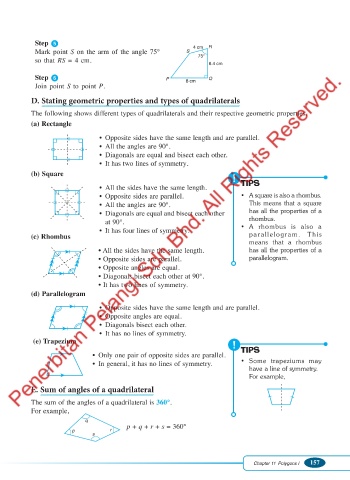
           D. Stating geometric properties and types of quadrilaterals

           The following shows different types of  quadrilaterals and their respective geometric properties.
           (a) Rectangle

                                •  Opposite sides have the same length and are parallel.
                                •  All the angles are 90°.
                                •  Diagonals are equal and  bisect each other.
                                •  It has two lines of  symmetry.
           (b) Square
                                                                           TIPS
                                •  All the sides have the same length.
                                •  Opposite sides are  parallel.           •  A square is also a rhombus.
                                •  All the angles are 90°.                    This means that a square
                                •  Diagonals are equal and  bisect each other   has all the properties of a
                                                                              rhombus.
                                 at 90°.                                   •  A rhombus is also a
                                •  It has four lines of  symmetry.
           (c) Rhombus                                                        parallelogram.  This
                                                                              means that a rhombus
                               • All the sides have the same length.          has all the properties of a
                               • Opposite sides are  parallel.                parallelogram.
                               • Opposite angles are equal.
                               • Diagonals bisect each other at 90°.
                               • It has two lines of  symmetry.
           (d) Parallelogram
                                •  Opposite sides have the same length and are parallel.
                                •  Opposite angles are equal.
                                •  Diagonals bisect each other.
                                •  It has no lines of  symmetry.
            (e) Trapezium
                                                                           TIPS
                             •  Only one pair of opposite sides are parallel.
                             •  In general, it has no lines of symmetry.   •  Some trapeziums may
                                                                              have a line of symmetry.
                                                                              For example,
           E. Sum of angles of a quadrilateral

           The sum of the angles of a quadrilateral is 360°.
           For example,
                           q
                                         p + q + r + s = 360°
                       p           r
                             s


                                                                               Chapter 11  Polygons I   157


                                                                                                14/07/2022   10:15 AM
   DA1501_pg 147 to 161.indd   157
   DA1501_pg 147 to 161.indd   157                                                              14/07/2022   10:15 AM

