


Page 70 - Buletin JSKM 2021
P. 70
69


                 SUMMARY OF ARTICLE “FIRST-TIME ODL EXPERIENCE AMONG B40 AND NON-
                   B40 STUDENTS IN PRE-DIPLOMA PROGRAMS: ASSESSING STUDENTS’ WELL
                                                        BEING”
                             Siti Mariam Saad, Siti Nurleena Abu Mansor and Mahanim Omar.

                       Over a year has passed after the massive transition of face-to-face teaching and learning
                (PdP) to online distance learning (ODL) due to the Covid-19 pandemic. Upon this date, ODL
                has  become  a  common  practice  for  primary,  secondary,  and  even  tertiary  education.  This
                sudden change affects all students from each level of income groups, no exception to the B40
                families. The hardship they endure during the pandemic not only to survive the retrenchment
                but  also  persisting  their  children  education.  The  B40  students  must  compete  between  all
                equipped students, with themselves whom barely have a computer. The aim of this study was
                to evaluate the B40 and non-B40 students on their perception on ODL and the supports they
                received from their families and lecturers. Data on first-time ODL experiences were collected
                using  self-administered  online  questionnaire  from  206  pre-diploma  students  in  UiTM
                Cawangan Pulau Pinang, consisting of 65 male and 141 female students. The data analysis was
                done quantitatively and descriptively.


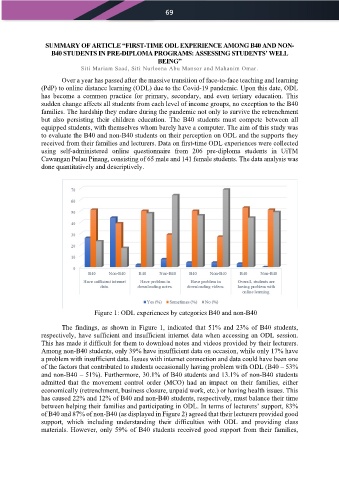
                                  Figure 1: ODL experiences by categories B40 and non-B40

                       The  findings,  as  shown  in  Figure  1,  indicated  that  51%  and  23%  of  B40  students,
                respectively, have sufficient and insufficient internet data when accessing an ODL session.
                This has made it difficult for them to download notes and videos provided by their lecturers.
                Among non-B40 students, only 39% have insufficient data on occasion, while only 17% have
                a problem with insufficient data. Issues with internet connection and data could have been one
                of the factors that contributed to students occasionally having problem with ODL (B40 – 53%
                and non-B40 – 51%). Furthermore, 30.1% of B40 students and 13.1% of non-B40 students
                admitted  that  the  movement  control  order  (MCO)  had  an  impact  on  their  families,  either
                economically (retrenchment, business closure, unpaid work, etc.) or having health issues. This
                has caused 22% and 12% of B40 and non-B40 students, respectively, must balance their time
                between helping their families and participating in ODL. In terms of lecturers’ support, 83%
                of B40 and 87% of non-B40 (as displayed in Figure 2) agreed that their lecturers provided good
                support,  which  including  understanding  their  difficulties  with  ODL  and  providing  class
                materials. However, only 59% of B40 students received good support from their families,

