


Page 84 - Buletin JSKM 2021
P. 84
83


                                    $            +             	     =
                 Rafizah Kechil, Noor 'Aina Abdul Razak, Siti Asmah Mohamed and Fuziatul Nosyiha Ahmad
                                                         Shukri
                       Allah is the creator of the universe who has complete authority over all that exists.
                Animals, plants, mountains, oceans, and planets, among other creations and objects, are all
                subject to Allah's will. Nature's beauty is a wonderful gift from Almighty Allah. As Allah's
                servants, we must do our role by studying Allah's creation with the brains that Allah has given
                us.
                       Special Group Interest – Computer Aided Geometric Design (SIG-CAGD) shall look
                at how the mathematical equations relate to nature in this article. We can appreciate the beauty
                of Allah's pattern creation through the relationship between mathematics equations and nature.
                One of the well-known mathematical equations that relate to nature is the Fibonacci Sequence.
                The Fibonacci sequence is given by series of numbers
                                                  0, 1, 1, 2, 3, 5, 8, 13, 21, 34, ...
                       The  following  number  is  found  by  adding  up  the  two  numbers  before.  Fibonacci
                sequence  was  first  discovered  by  Al-Khwarizmi,  a  profound  Muslim  mathematician.
                Fibonacci, the Italian mathematician, was the one who introduced the sequence of Fibonacci
                numbers to Europe (Mastin, 2010; Asy-Syaimaa’Hussain & Ramli, 2017; Majid, 2019). The
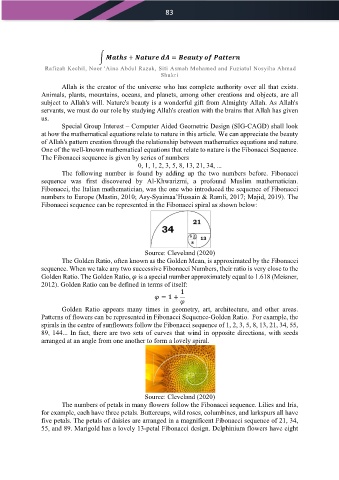
                Fibonacci sequence can be represented in the Fibonacci spiral as shown below:


                                                    Source: Cleveland (2020)
                       The Golden Ratio, often known as the Golden Mean, is approximated by the Fibonacci
                sequence. When we take any two successive Fibonacci Numbers, their ratio is very close to the
                Golden Ratio. The Golden Ratio,    is a special number approximately equal to 1.618 (Meisner,
                2012). Golden Ratio can be defined in terms of itself:
                                                                1
                                                          = 1 +

                       Golden  Ratio  appears  many  times  in  geometry,  art,  architecture,  and  other  areas.
                Patterns of flowers can be represented in Fibonacci Sequence-Golden Ratio.  For example, the
                spirals in the centre of sunflowers follow the Fibonacci sequence of 1, 2, 3, 5, 8, 13, 21, 34, 55,
                89, 144... In fact, there are two sets of curves that wind in opposite directions, with seeds
                arranged at an angle from one another to form a lovely spiral.


                                                    Source: Cleveland (2020)
                       The numbers of petals in many flowers follow the Fibonacci sequence. Lilies and Iris,
                for example, each have three petals. Buttercups, wild roses, columbines, and larkspurs all have
                five petals. The petals of daisies are arranged in a magnificent Fibonacci sequence of 21, 34,
                55, and 89. Marigold has a lovely 13-petal Fibonacci design. Delphinium flowers have eight

