


Page 125 - The Design Thinking Playbook
P. 125
EXPERT TIP
                     Carry out an A/B testing

                     with your prototype


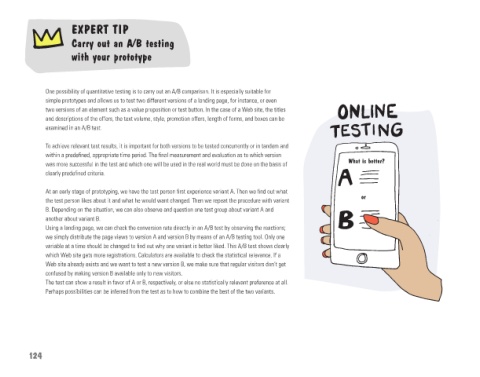
              One possibility of quantitative testing is to carry out an A/B comparison. It is especially suitable for
              simple prototypes and allows us to test two different versions of a landing page, for instance, or even
              two versions of an element such as a value proposition or test button. In the case of a Web site, the titles
              and descriptions of the offers, the text volume, style, promotion offers, length of forms, and boxes can be
              examined in an A/B test.

              To achieve relevant test results, it is important for both versions to be tested concurrently or in tandem and
              within a predefined, appropriate time period. The final measurement and evaluation as to which version
              was more successful in the test and which one will be used in the real world must be done on the basis of   What is better?
              clearly predefined criteria.


              At an early stage of prototyping, we have the test person first experience variant A. Then we find out what
              the test person likes about it and what he would want changed. Then we repeat the procedure with variant   or
              B. Depending on the situation, we can also observe and question one test group about variant A and
              another about variant B.
              Using a landing page, we can check the conversion rate directly in an A/B test by observing the reactions;
              we simply distribute the page views to version A and version B by means of an A/B testing tool. Only one
              variable at a time should be changed to find out why one variant is better liked. This A/B test shows clearly
              which Web site gets more registrations. Calculators are available to check the statistical relevance. If a
              Web site already exists and we want to test a new version B, we make sure that regular visitors don’t get
              confused by making version B available only to new visitors.
              The test can show a result in favor of A or B, respectively, or else no statistically relevant preference at all.
              Perhaps possibilities can be inferred from the test as to how to combine the best of the two variants.


         124

