


Page 123 - The Design Thinking Playbook
P. 123
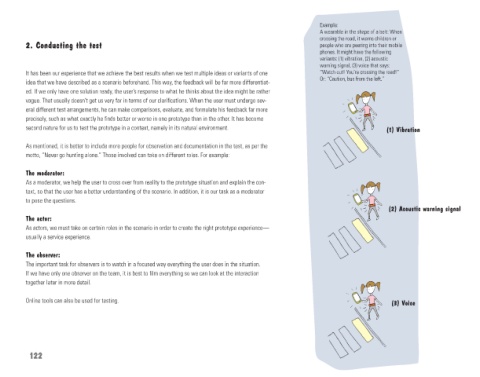
Example:
                                                                                            A wearable in the shape of a belt: When
                                                                                            crossing the road, it warns children or
        2. Conducting the test                                                              people who are peering into their mobile
                                                                                            phones. It might have the following
                                                                                            variants: (1) vibration, (2) acoustic
                                                                                            warning signal, (3) voice that says:
        It has been our experience that we achieve the best results when we test multiple ideas or variants of one   “Watch out! You’re crossing the road!”
        idea that we have described as a scenario beforehand. This way, the feedback will be far more differentiat-  Or: “Caution, bus from the left.”
        ed. If we only have one solution ready, the user’s response to what he thinks about the idea might be rather
        vague. That usually doesn’t get us very far in terms of our clarifications. When the user must undergo sev-
        eral different test arrangements, he can make comparisons, evaluate, and formulate his feedback far more
        precisely, such as what exactly he finds better or worse in one prototype than in the other. It has become
        second nature for us to test the prototype in a context, namely in its natural environment.             (1) Vibration

        As mentioned, it is better to include more people for observation and documentation in the test, as per the
        motto, “Never go hunting alone.” Those involved can take on different roles. For example:

        The moderator:
        As a moderator, we help the user to cross over from reality to the prototype situation and explain the con-
        text, so that the user has a better understanding of the scenario. In addition, it is our task as a moderator
        to pose the questions.
                                                                                                                (2) Acoustic warning signal
        The actor:
        As actors, we must take on certain roles in the scenario in order to create the right prototype experience—
        usually a service experience.

        The observer:
        The important task for observers is to watch in a focused way everything the user does in the situation.
        If we have only one observer on the team, it is best to film everything so we can look at the interaction
        together later in more detail.

        Online tools can also be used for testing.                                                               (3) Voice


          122

