


Page 124 - The Design Thinking Playbook
P. 124
3 Document results


             In our experience, it is of vital importance to document the results. In so doing, we actively observe how   As an alternative, we can choose the following areas for the four
             the users use (and misuse!) what we have given them. We do not immediately correct what our test   quadrants: “I like…,” “I wish…,” “What if…,” and “What is the
             person is doing. Photos or video recordings are very suitable for documentation. We always ask the users   benefit?”
             for their permission. Digital tools make documentation easier, but be careful not to forget to use them. To   This method can be easily applied to groups consisting of two to over
             elict  richer answers, we probe with further questions. It’s very important and often constitutes the most   100 people. The simple structure helps to formulate constructive
             valuable part of the tests. Questions can be, for example, “Can you say more about how it feels to you?”   feedback.
             “Why?” and “Show us why this would (not) work for you.” Ideally, we answer questions with questions:
             “What do you think this button is for?” Resist the temptation to conduct a marketing or voice-of-the-   Giving feedback is one thing, receiving feedback quite another. When
             customer survey!                                                        we receive feedback, we should see it as a gift and express our
                                                                                     gratitude. We listen to the feedback and do not have to answer in
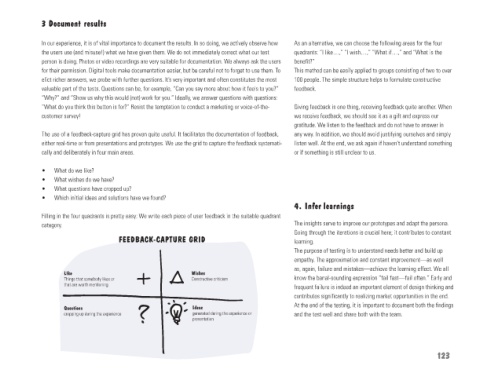
             The use of a feedback-capture grid has proven quite useful. It facilitates the documentation of feedback,   any way. In addition, we should avoid justifying ourselves and simply
             either real-time or from presentations and prototypes. We use the grid to capture the feedback systemati-  listen well. At the end, we ask again if haven’t understand something
             cally and deliberately in four main areas.                              or if something is still unclear to us.


             •   What do we like?
             •   What wishes do we have?
             •   What questions have cropped up?
             •   Which initial ideas and solutions have we found?
                                                                                     4. Infer learnings
             Filling in the four quadrants is pretty easy: We write each piece of user feedback in the suitable quadrant
             category.                                                               The insights serve to improve our prototypes and adapt the persona.
                                                                                     Going through the iterations is crucial here; it contributes to constant
                                   FEEDBACK-CAPTURE GRID                             learning.
                                                                                     The purpose of testing is to understand needs better and build up
                                                                                     empathy. The approximation and constant improvement—as well
                                                                                     as, again, failure and mistakes—achieve the learning effect. We all
                   Like                                 Wishes
                   Things that somebody likes or        Constructive criticism       know the banal-sounding expression “fail fast—fail often.” Early and
                   that are worth mentioning                                         frequent failure is indeed an important element of design thinking and
                                                                                     contributes significantly to realizing market opportunities in the end.
                   Questions                            Ideas                        At the end of the testing, it is important to document both the findings
                   cropping up during the experience    generated during the experience or   and the test well and share both with the team.
                                                        presentation


                                                                                                                              123

