


Page 153 - The Design Thinking Playbook
P. 153
EXPERT TIP

                    Recruiting an interdisciplinary
                    team with T profiles


         The ideal is that we can equip our teams with people who have differ-  If we have little time and want to learn something quickly about the participants in a workshop, we still
         ent preferences in their thinking; this is how we get high-performance   use the model of the two halves of the brain. It helps to classify the participants roughly into the catego-
         teams in the end. The myth that the left hemisphere of the brain   ries of “analytical/systematic” versus “intuitive/iterative.” We have learned that the combination of the
         is responsible for analytical thinking and the right hemisphere for   various thinking models and thinking preferences is essential for a successful design thinking project.
         holistic thinking is widespread. But because our brain is anything but
         well organized, such a simple division into two halves is quite wrong.
         Tendencies can indeed be identified. Our understanding of numbers,
                                                                                                        ®
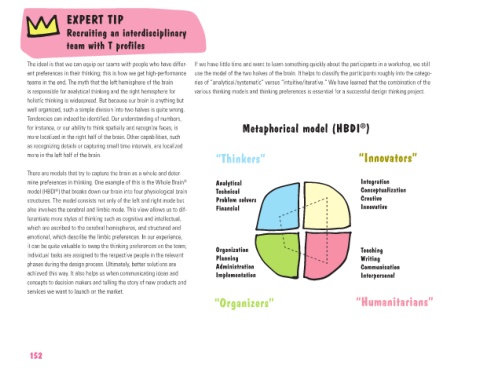
         for instance, or our ability to think spatially and recognize faces, is   Metaphorical model (HBDI )
         more localized in the right half of the brain. Other capabilities, such
         as recognizing details or capturing small time intervals, are localized
         more in the left half of the brain.                   “Thinkers”                               “Innovators”

         There are models that try to capture the brain as a whole and deter-
         mine preferences in thinking. One example of this is the Whole Brain    Analytical             Integration
                                                      ®
         model (HBDI ) that breaks down our brain into four physiological brain   Technical             Conceptualization
                 ®
         structures. The model consists not only of the left and right mode but   Problem solvers       Creative
         also involves the cerebral and limbic mode. This view allows us to dif-  Financial             Innovative
         ferentiate more styles of thinking such as cognitive and intellectual,
         which are ascribed to the cerebral hemispheres, and structured and
         emotional, which describe the limbic preferences. In our experience,
         it can be quite valuable to swap the thinking preferences on the team;   Organization          Teaching
         individual tasks are assigned to the respective people in the relevant   Planning              Writing
         phases during the design process. Ultimately, better solutions are   Administration            Communication
         achieved this way. It also helps us when communicating ideas and   Implementation              Interpersonal
         concepts to decision makers and telling the story of new products and
         services we want to launch on the market.
                                                              “Organizers”                             “Humanitarians”


          152

