


Page 172 - The Design Thinking Playbook
P. 172
EXPERT TIP

                         How can empathy be understood
                         as a design paradigm?

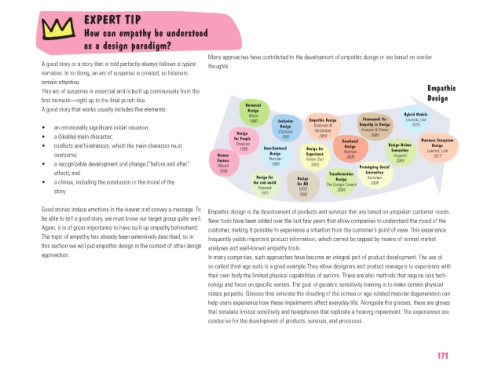
                                                             Many approaches have contributed to the development of empathic design or are based on similar
             A good story or a story that is told perfectly always follows a typical   thoughts.
             narrative. In so doing, an arc of suspense is created, so listeners
             remain attentive.
             This arc of suspense is essential and is built up continuously from the                                       Empathic
             first moment—right up to the final punch line.                                                                Design
                                                                       Universal
             A good story that works usually includes five elements:    Design
                                                                        Mace                                        Hybrid Models
                                                                        1980     Inclusive  Empathic Design   Framework for   Lewrick, Link
             •   an emotionally significant initial situation;                   Design    Koskinen &   Empathy in Design  2015
                                                                                                        Kourpie & Visser
                                                                     Design      Coleman   Battarbee
             •   a (likable) main character;                        for People   1991       2003           2009          Business Ecosystem
             •   conflicts and hindrances, which the main character must   Dreyfuss                Emotional    Design-Driven  Design
                                                                                                    Design
                                                                     1955   User-Centered   Design for           Innovation  Lewrick, Link
                overcome;                                      Human          Design     Experience  Norman      Verganti    2017
                                                                                                    2005
                                                               Factors        Norman     Fulton Suri              2009
             •   a recognizable development and change (“before and after”   Morell   1988   2003       Prototyping Social
                effect); and                                    1950                           Transformation  Interaction
                                                                          Design for  Design     Design   Kurvinen
             •   a climax, including the conclusion or the moral of the   the real world  for All  The Design Council  2008
                                                                           Papanek    EIDD
                story.                                                      1971      1995       2004
             Good stories induce emotions in the viewer and convey a message. To   Empathic design is the development of products and services that are based on unspoken customer needs.
             be able to tell a good story, we must know our target group quite well.   New tools have been added over the last few years that allow companies to understand the mood of the
             Again, it is of great importance to have built up empathy beforehand.   customer, making it possible to experience a situation from the customer’s point of view. This experience
             The topic of empathy has already been extensively described, so in   frequently yields important product information, which cannot be tapped by means of normal market
             this section we will put empathic design in the context of other design   analyses and well-known empathy tools.
             approaches.                                     In many companies, such approaches have become an integral part of product development. The use of
                                                             so-called third-age suits is a good example.They allow designers and product managers to experience with
                                                             their own body the limited physical capabilities of seniors. There are also methods that require less tech-
                                                             nology and focus on specific senses. The goal of geriatric sensitivity training is to make certain physical
                                                             states palpable. Glasses that simulate the clouding of the cornea or age-related macular degeneration can
                                                             help users experience how these impairments affect everyday life. Alongside the glasses, there are gloves
                                                             that simulate limited sensitivity and headphones that replicate a hearing impairment. The experiences are
                                                             conducive for the development of products, services, and processes.


                                                                                                                              171

