


Page 176 - The Design Thinking Playbook
P. 176
EXPERT TIP

                          Telling stories in order to communicate
                          a future vision


             Design trends such as a popular style, and hip combinations or colors are not the real trend. These
             attributes are only the tip of the iceberg. To identify the true trends, you have to dig deeper. This is the only
             way to reveal the artifacts. Changed behaviors, beliefs, and social forces make up a trend.

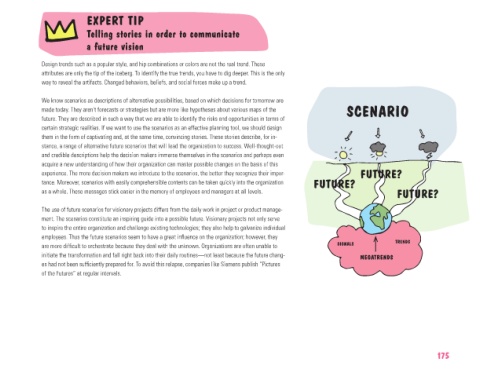
             We know scenarios as descriptions of alternative possibilities, based on which decisions for tomorrow are
             made today. They aren’t forecasts or strategies but are more like hypotheses about various maps of the   SCENARIO
             future. They are described in such a way that we are able to identify the risks and opportunities in terms of
             certain strategic realities. If we want to use the scenarios as an effective planning tool, we should design
             them in the form of captivating and, at the same time, convincing stories. These stories describe, for in-
             stance, a range of alternative future scenarios that will lead the organization to success. Well-thought-out
             and credible descriptions help the decision makers immerse themselves in the scenarios and perhaps even
             acquire a new understanding of how their organization can master possible changes on the basis of this
             experience. The more decision makers we introduce to the scenarios, the better they recognize their impor-  FUTURE?
             tance. Moreover, scenarios with easily comprehensible contents can be taken quickly into the organization   FUTURE?
             as a whole. These messages stick easier in the memory of employees and managers at all levels.       FUTURE?

             The use of future scenarios for visionary projects differs from the daily work in project or product manage-
             ment. The scenarios constitute an inspiring guide into a possible future. Visionary projects not only serve
             to inspire the entire organization and challenge existing technologies; they also help to galvanize individual
             employees. Thus the future scenarios seem to have a great influence on the organization; however, they
             are more difficult to orchestrate because they deal with the unknown. Organizations are often unable to   SIGNALS  TRENDS
             initiate the transformation and fall right back into their daily routines—not least because the future chang-  MEGATRENDS
             es had not been sufficiently prepared for. To avoid this relapse, companies like Siemens publish “Pictures
             of the Futures” at regular intervals.


                                                                                                                              175

