


Page 175 - The Design Thinking Playbook
P. 175
EXPERT TIP

                      Stories that generate
                      emotional needs


        We all know the problem of how the respondents in a direct user survey describe their own behavior as   In the ideal case, the respondents wrote down a little story they made
        an ideal type but do not show their true self. We ask them about their goals and desires, but the reply only   up about how the person got out of the difficult situation. They were
        consists of the most obvious insights. One way to reach users on a more emotional level is to offer stories   asked not to reflect too critically on what is possible or impossible in
        of their dreams, which give us the opportunity to learn things that go deeper and reveal their true needs   reality. Ideally, the whole thing was pepped up with drawings. The
        and desires.                                                             length, content, and depth of the story were irrelevant.

        A project with the name “wearable dreams” is a good example of how such stories about dreams can   The design process builds on this information. The idea behind it
        provide an inspiring framework for a design thinking project. In this project, the interviewees were initially   is that objects must satisfy our emotional needs, for one. Also, our
        asked to imagine that their favorite piece of clothing was a person. Then they were asked to describe the   rational stories are the best way to transport these needs.
        personality of this person:


        •   What is the name of the favorite piece of clothing?
        •   How old is it, and what does it do for a living?
        •   Is it pretty shy or rather extroverted?
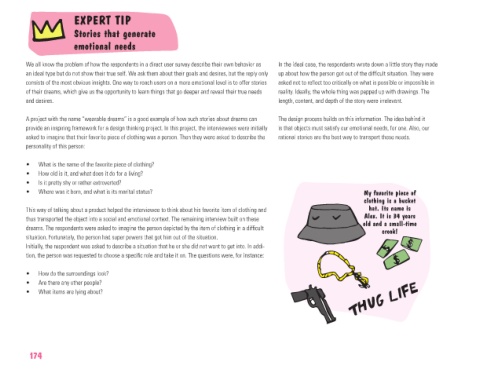
        •   Where was it born, and what is its marital status?                                           My favorite piece of
                                                                                                         clothing is a bucket
        This way of talking about a product helped the interviewee to think about his favorite item of clothing and   hat. Its name is
        thus transported the object into a social and emotional context. The remaining interview built on these   Alex. It is 34 years
        dreams. The respondents were asked to imagine the person depicted by the item of clothing in a difficult   old and a small-time
                                                                                                              crook!
        situation. Fortunately, the person had super powers that got him out of the situation.
        Initially, the respondent was asked to describe a situation that he or she did not want to get into. In addi-
        tion, the person was requested to choose a specific role and take it on. The questions were, for instance:

        •   How do the surroundings look?
        •   Are there any other people?
        •   What items are lying about?


          174

