


Page 207 - The Design Thinking Playbook
P. 207
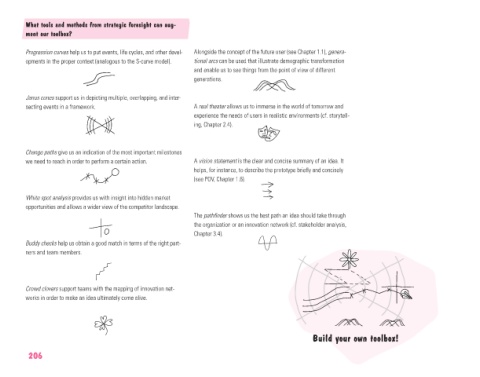
What tools and methods from strategic foresight can aug-
        ment our toolbox?


        Progression curves help us to put events, life cycles, and other devel-  Alongside the concept of the future user (see Chapter 1.1), genera-
        opments in the proper context (analogous to the S-curve model).  tional arcs can be used that illustrate demographic transformation
                                                        and enable us to see things from the point of view of different
                                                        generations.


        Janus cones support us in depicting multiple, overlapping, and inter-
        secting events in a framework.                  A real theater allows us to immerse in the world of tomorrow and
                                                        experience the needs of users in realistic environments (cf. storytell-
                                                        ing, Chapter 2.4).


        Change paths give us an indication of the most important milestones
        we need to reach in order to perform a certain action.  A vision statement is the clear and concise summary of an idea. It
                                                        helps, for instance, to describe the prototype briefly and concisely
                                                        (see POV, Chapter 1.6).


        White spot analysis provides us with insight into hidden market
        opportunities and allows a wider view of the competitor landscape.
                                                        The pathfinder shows us the best path an idea should take through
                                                        the organization or an innovation network (cf. stakeholder analysis,
                                                        Chapter 3.4).
        Buddy checks help us obtain a good match in terms of the right part-
        ners and team members.


        Crowd clovers support teams with the mapping of innovation net-
        works in order to make an idea ultimately come alive.


                                                                                          Build your own toolbox!

         206

