


Page 202 - The Design Thinking Playbook
P. 202
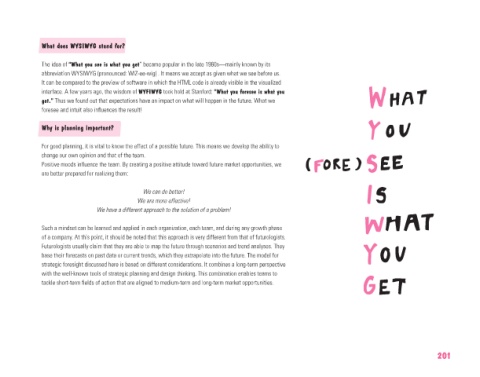
What does WYSIWYG stand for?

             The idea of “What you see is what you get” became popular in the late 1960s—mainly known by its
             abbreviation WYSIWYG (pronounced: WIZ-ee-wig) . It means we accept as given what we see before us.
             It can be compared to the preview of software in which the HTML code is already visible in the visualized
             interface. A few years ago, the wisdom of WYFIWYG took hold at Stanford: “What you foresee is what you
             get.” Thus we found out that expectations have an impact on what will happen in the future. What we
             foresee and intuit also influences the result!

             Why is planning important?

             For good planning, it is vital to know the effect of a possible future. This means we develop the ability to
             change our own opinion and that of the team.
             Positive moods influence the team. By creating a positive attitude toward future market opportunities, we
             are better prepared for realizing them:

                                          We can do better!
                                        We are more effective!
                             We have a different approach to the solution of a problem!

             Such a mindset can be learned and applied in each organization, each team, and during any growth phase
             of a company. At this point, it should be noted that this approach is very different from that of futurologists.
             Futurologists usually claim that they are able to map the future through scenarios and trend analyses. They
             base their forecasts on past data or current trends, which they extrapolate into the future. The model for
             strategic foresight discussed here is based on different considerations. It combines a long-term perspective
             with the well-known tools of strategic planning and design thinking. This combination enables teams to
             tackle short-term fields of action that are aligned to medium-term and long-term market opportunities.


                                                                                                                              201

