


Page 225 - The Design Thinking Playbook
P. 225
3.2  How to apply lean business model thinking


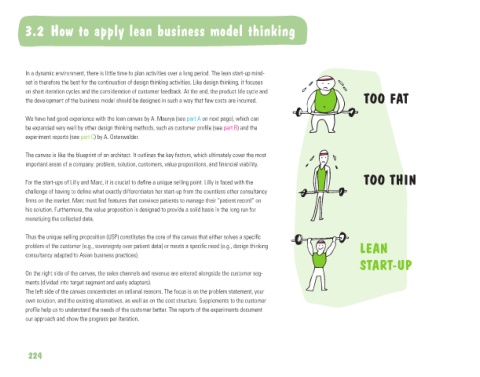
        In a dynamic environment, there is little time to plan activities over a long period. The lean start-up mind-
        set is therefore the best for the continuation of design thinking activities. Like design thinking, it focuses
        on short iteration cycles and the consideration of customer feedback. At the end, the product life cycle and
        the development of the business model should be designed in such a way that few costs are incurred.   TOO FAT

        We have had good experience with the lean canvas by A. Maurya (see part A on next page), which can
        be expanded very well by other design thinking methods, such as customer profile (see part B) and the
        experiment reports (see part C) by A. Osterwalder.

        The canvas is like the blueprint of an architect. It outlines the key factors, which ultimately cover the most
        important areas of a company: problem, solution, customers, value propositions, and financial viability.
                                                                                                         TOO THIN
        For the start-ups of Lilly and Marc, it is crucial to define a unique selling point. Lilly is faced with the
        challenge of having to define what exactly differentiates her start-up from the countless other consultancy
        firms on the market. Marc must find features that convince patients to manage their “patient record” on
        his solution. Furthermore, the value proposition is designed to provide a solid basis in the long run for
        monetizing the collected data.


        Thus the unique selling proposition (USP) constitutes the core of the canvas that either solves a specific
        problem of the customer (e.g., sovereignty over patient data) or meets a specific need (e.g., design thinking   LEAN
        consultancy adapted to Asian business practices).
                                                                                                        START-UP
        On the right side of the canvas, the sales channels and revenue are entered alongside the customer seg-
        ments (divided into target segment and early adapters).
        The left side of the canvas concentrates on rational reasons. The focus is on the problem statement, your
        own solution, and the existing alternatives, as well as on the cost structure. Supplements to the customer
        profile help us to understand the needs of the customer better. The reports of the experiments document
        our approach and show the progress per iteration.


         224

