


Page 244 - The Design Thinking Playbook
P. 244
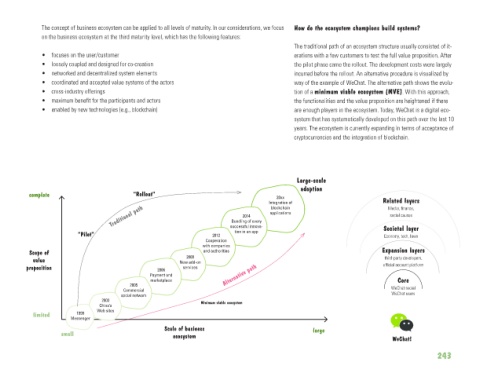
The concept of business ecosystem can be applied to all levels of maturity. In our considerations, we focus   How do the ecosystem champions build systems?
             on the business ecosystem at the third maturity level, which has the following features:
                                                                                     The traditional path of an ecosystem structure usually consisted of it-
             •  focuses on the user/customer                                         erations with a few customers to test the full value proposition. After
             •  loosely coupled and designed for co-creation                         the pilot phase came the rollout. The development costs were largely
             •  networked and decentralized system elements                          incurred before the rollout. An alternative procedure is visualized by
             •  coordinated and accepted value systems of the actors                 way of the example of WeChat. The alternative path shows the evolu-
             •  cross-industry offerings                                             tion of a minimum viable ecosystem (MVE). With this approach,
             •  maximum benefit for the participants and actors                      the functionalities and the value proposition are heightened if there
             •  enabled by new technologies (e.g., blockchain)                       are enough players in the ecosystem. Today, WeChat is a digital eco-
                                                                                     system that has systematically developed on this path over the last 10
                                                                                     years. The ecosystem is currently expanding in terms of acceptance of
                                                                                     cryptocurrencies and the integration of blockchain.


                                                                                      Large-scale
                                                                                       adoption
         complete                      “Rollout”                                20xx
                                                                              Integration of                  Related layers
                                 Traditional path                  Bundling of every   applications             social causes
                                                                              blockchain
                                                                                                                Media, finance,
                                                                      2014
                                                                    tion in an app
                       “Pilot”                                2012  successful innova-                         Societal layer
                                                                                                               Economy, tech, laws
                                                            Cooperation
                                                           with companies
         Scope of                                          and authorities                                    Expansion layers
                                                      2008
          value                                     New add-on                                                 third-party developers,
        proposition                           2006   services                                                  official account platform
                                            Payment and          Alternative path
                                            marketplace                                                            Core
                                      2005
                                    Commercial                                                                   WeChat social
                                    social network                                                               WeChat users
                              2003                        Minimum viable ecosystem
                             China’s
          limited      1999  Web sites
                     Messenger
                                                Scale of business                         large
                   small                          ecosystem                                                      WeChat!
                                                                                                                              243

