


Page 242 - The Design Thinking Playbook
P. 242
Another example is Amazon. Alongside its original core business,
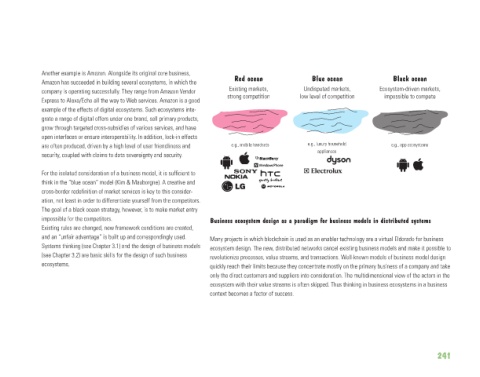
             Amazon has succeeded in building several ecosystems, in which the   Red ocean  Blue ocean           Black ocean
             company is operating successfully. They range from Amazon Vendor   Existing markets,  Undisputed markets,   Ecosystem-driven markets,
             Express to Alexa/Echo all the way to Web services. Amazon is a good   strong competition  low level of competition  impossible to compete
             example of the effects of digital ecosystems. Such ecosystems inte-
             grate a range of digital offers under one brand, sell primary products,
             grow through targeted cross-subsidies of various services, and have
             open interfaces or ensure interoperability. In addition, lock-in effects
             are often produced, driven by a high level of user friendliness and   e.g., mobile handsets  e.g., luxury household   e.g., app ecosystems
             security, coupled with claims to data sovereignty and security.                appliances

             For the isolated consideration of a business model, it is sufficient to
             think in the “blue ocean” model (Kim & Mauborgne). A creative and
             cross-border redefinition of market services is key to this consider-
             ation, not least in order to differentiate yourself from the competitors.
             The goal of a black ocean strategy, however, is to make market entry
             impossible for the competitors.                 Business ecosystem design as a paradigm for business models in distributed systems
             Existing rules are changed, new framework conditions are created,
             and an “unfair advantage” is built up and correspondingly used.   Many projects in which blockchain is used as an enabler technology are a virtual Eldorado for business
             Systems thinking (see Chapter 3.1) and the design of business models   ecosystem design. The new, distributed networks cancel existing business models and make it possible to
             (see Chapter 3.2) are basic skills for the design of such business   revolutionize processes, value streams, and transactions. Well-known models of business model design
             ecosystems.                                     quickly reach their limits because they concentrate mostly on the primary business of a company and take
                                                             only the direct customers and suppliers into consideration. The multidimensional view of the actors in the
                                                             ecosystem with their value streams is often skipped. Thus thinking in business ecosystems in a business
                                                             context becomes a factor of success.


                                                                                                                              241

