


Page 277 - The Design Thinking Playbook
P. 277
EXPERT TIP
                     Design of “emotions” with robots


        Emotions in the robot–human relationship are just as important as
        trust. The human expects the robot to recognize emotions and to act
        accordingly. There is no doubt that human beings have emotions and
        that their behavior is influenced by emotions. Our behavior in street
        traffic is a good example: Our driving style is influenced by our emo-
        tions. And we react to the driving style of others. We are in a hurry
        because we must get to an appointment. We are relaxed because we
        are just starting off on our vacation. We drive aggressively because                 You look
        we have had a bad day. How does a self-driving car handle such                        happy!
        emotions and tendencies? The robot must adapt its behavior and, for
        example, drive faster (more aggressively) or slower (more cautiously).
        If necessary, it must adjust the route because either we want to enjoy
        the scenery or get from A to B as quickly as possible. One possibility
        is that, in the future, we transfer our personality and our preferences
        like a personal DNA to distributed systems and thus provide a stock
        of information. Another possibility is for various sensors to transmit
        additional information in real time, which helps the robot make the
        right decision for the emotional situation easily and quickly.
        Hence the recognition of emotions and the situational adaptation
        of behavior will be of an even greater significance in the future. The
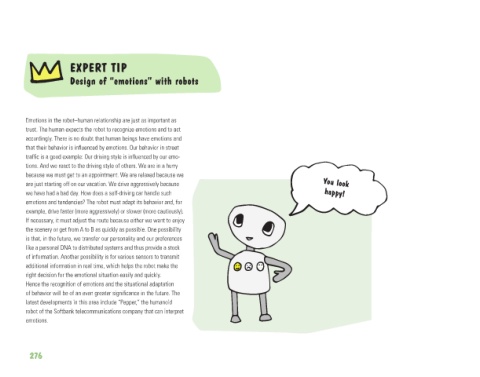
        latest developments in this area include “Pepper,” the humanoid
        robot of the Softbank telecommunications company that can interpret
        emotions.


         276

