


Page 315 - The Design Thinking Playbook
P. 315
Closing words


        What have we learned on the journey?


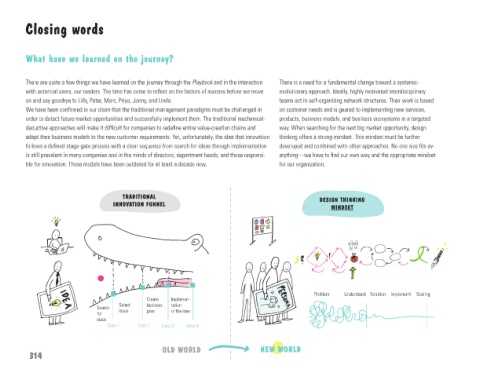
        There are quite a few things we have learned on the journey through the Playbook and in the interaction   There is a need for a fundamental change toward a systemic-
        with potential users, our readers. The time has come to reflect on the factors of success before we move   evolutionary approach. Ideally, highly motivated interdisciplinary
        on and say goodbye to Lilly, Peter, Marc, Priya, Jonny, and Linda.       teams act in self-organizing network structures. Their work is based
        We have been confirmed in our claim that the traditional management paradigms must be challenged in   on customer needs and is geared to implementing new services,
        order to detect future market opportunities and successfully implement them. The traditional mechanical-   products, business models, and business ecosystems in a targeted
        deductive approaches will make it difficult for companies to redefine entire value-creation chains and   way. When searching for the next big market opportunity, design
        adapt their business models to the new customer requirements. Yet, unfortunately, the idea that innovation   thinking offers a strong mindset. This mindset must be further
        follows a defined stage-gate process with a clear sequence from search for ideas through implementation   developed and combined with other approaches. No one size fits ev-
        is still prevalent in many companies and in the minds of directors, department heads, and those responsi-  erything—we have to find our own way and the appropriate mindset
        ble for innovation. These models have been outdated for at least a decade now.  for our organization.


                                    TRADITIONAL                                             DESIGN THINKING
                                 INNOVATION FUNNEL                                              MINDSET


                                                                                           Problem  Understand Solution  Implement  Scaling
                                           Create   Implemen-
                                   Select  business  tation
                             Search   ideas
                             for           plan   of the idea
                             ideas
                                Gate 1   Gate 2  Gate 3  Gate 4


                                               OLD WORLD                   NEW WORLD
         314

