


Page 310 - The Design Thinking Playbook
P. 310
EXPERT TIP

                                                 Convince stakeholders of the approach


                                     The hybrid approach compensates for the weaknesses of the unified approaches. Introducing a combined mindset has better chances of success
                                     than introducing one after the other sequentially.
                                     In our experience, both top-down and bottom-up work.

                                     With a bottom-up approach, the exchange between employees who deal with the subject of design thinking and those who are into data is
                                     promoted. In workshops, the two groups can present their approaches and challenges to each other. It quickly becomes apparent that the two
                                     approaches are complementary. The goal is to find a common pilot project in which the collaboration can initially be tested.
                                     In a top-down approach, the advantages and disadvantages of both mindsets are presented to top management with the goal of carrying out
                                     an initial pilot project using the method of the hybrid model. After the pilot project is completed, the experienced gathered and the advantages
                                     are reported to top management and the stakeholders. In general, the hybrid approach reduces a number of risk factors; for example, it lowers
                                     the innovation risk of early experiments. In interdisciplinary teams, not only are new skills brought to the projects but also different ideas, which
                                     broaden the perspective. The same applies to a combination of systems thinking and design thinking and to projects that link strategic foresight
                                     to design thinking.


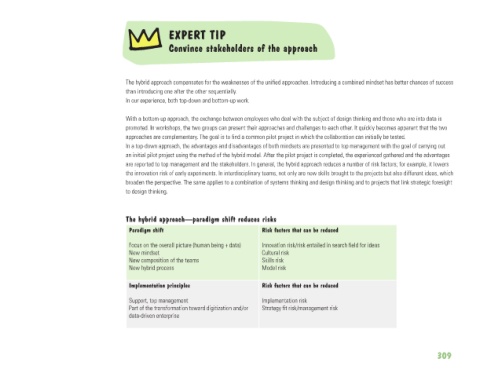
                                     The hybrid approach—paradigm shift reduces risks
                                      Paradigm shift                        Risk factors that can be reduced

                                      Focus on the overall picture (human being + data)  Innovation risk/risk entailed in search field for ideas
                                      New mindset                           Cultural risk
                                      New composition of the teams          Skills risk
                                      New hybrid process                    Model risk

                                      Implementation principles             Risk factors that can be reduced

                                      Support, top management               Implementation risk
                                      Part of the transformation toward digitization and/or   Strategy fit risk/management risk
                                      data-driven enterprise


                                                                                                                              309

