


Page 325 - The Design Thinking Playbook
P. 325
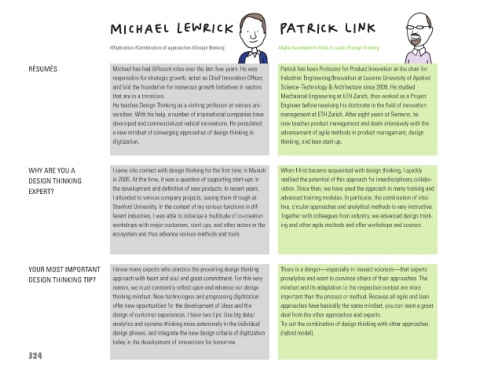
#Digitization #Combination of approaches #Design thinking  #Agile development #Idea to scale #Design thinking


         RÉSUMÉS                 Michael has had different roles over the last few years. He was   Patrick has been Professor for Product Innovation at the chair for
                                 responsible for strategic growth, acted as Chief Innovation Officer,   Industrial Engineering/Innovation at Lucerne University of Applied
                                 and laid the foundation for numerous growth initiatives in sectors   Science–Technology & Architecture since 2009. He studied
                                 that are in a transition.                       Mechanical Engineering at ETH Zurich, then worked as a Project
                                 He teaches Design Thinking as a visiting professor at various uni-  Engineer before receiving his doctorate in the field of innovation
                                 versities. With his help, a number of international companies have   management at ETH Zurich. After eight years at Siemens, he
                                 developed and commercialized radical innovations. He postulated   now teaches product management and deals intensively with the
                                 a new mindset of converging approaches of design thinking in   advancement of agile methods in product management, design
                                 digitization.                                   thinking, and lean start-up.


         WHY ARE YOU A           I came into contact with design thinking for the first time in Munich   When I first became acquainted with design thinking, I quickly
         DESIGN THINKING         in 2005. At the time, it was a question of supporting start-ups in   realized the potential of this approach for interdisciplinary collabo-
         EXPERT?                 the development and definition of new products. In recent years,   ration. Since then, we have used the approach in many training and
                                 I attended to various company projects, seeing them through at   advanced training modules. In particular, the combination of intui-
                                 Stanford University. In the context of my various functions in dif-  tive, circular approaches and analytical methods is very instructive.
                                 ferent industries, I was able to initialize a multitude of co-creation   Together with colleagues from industry, we advanced design think-
                                 workshops with major customers, start-ups, and other actors in the   ing and other agile methods and offer workshops and courses.
                                 ecosystem and thus advance various methods and tools.


         YOUR MOST IMPORTANT     I know many experts who practice the prevailing design thinking   There is a danger—especially in inexact sciences—that experts
         DESIGN THINKING TIP?    approach with heart and soul and great commitment. For this very   proselytize and want to convince others of their approaches. The
                                 reason, we must constantly reflect upon and advance our design   mindset and its adaptation to the respective context are more
                                 thinking mindset. New technologies and progressing digitization   important than the process or method. Because all agile and lean
                                 offer new opportunities for the development of ideas and the   approaches have basically the same mindset, you can learn a great
                                 design of customer experiences. I have two tips: Use big data/  deal from the other approaches and experts.
                                 analytics and systems thinking more extensively in the individual   Try out the combination of design thinking with other approaches
                                 design phases, and integrate the new design criteria of digitization   (hybrid model).
                                 today in the development of innovations for tomorrow.
         324

