


Page 51 - The Design Thinking Playbook
P. 51
1.3 How to get a good problem statement


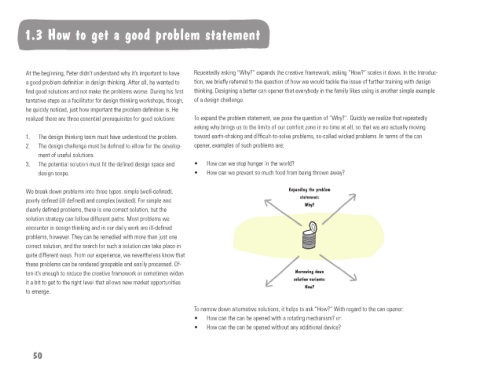
        At the beginning, Peter didn’t understand why it’s important to have   Repeatedly asking “Why?” expands the creative framework; asking “How?” scales it down. In the Introduc-
        a good problem definition in design thinking. After all, he wanted to   tion, we briefly referred to the question of how we would tackle the issue of further training with design
        find good solutions and not make the problems worse. During his first   thinking. Designing a better can opener that everybody in the family likes using is another simple example
        tentative steps as a facilitator for design thinking workshops, though,   of a design challenge.
        he quickly noticed, just how important the problem definition is. He
        realized there are three essential prerequisites for good solutions:    To expand the problem statement, we pose the question of “Why?”. Quickly we realize that repeatedly
                                                        asking why brings us to the limits of our comfort zone in no time at all, so that we are actually moving
        1.   The design thinking team must have understood the problem.  toward earth-shaking and difficult-to-solve problems, so-called wicked problems. In terms of the can
        2.   The design challenge must be defined to allow for the develop-  opener, examples of such problems are:
            ment of useful solutions.
        3.   The potential solution must fit the defined design space and   •   How can we stop hunger in the world?
            design scope.                               •   How can we prevent so much food from being thrown away?


        We break down problems into three types: simple (well-defined),             Expanding the problem
        poorly defined (ill-defined) and complex (wicked). For simple and              statement:
        clearly defined problems, there is one correct solution, but the                Why?
        solution strategy can follow different paths. Most problems we
        encounter in design thinking and in our daily work are ill-defined
        problems, however. They can be remedied with more than just one
        correct solution, and the search for such a solution can take place in
        quite different ways. From our experience, we nevertheless know that
        these problems can be rendered graspable and easily processed. Of-
        ten it’s enough to reduce the creative framework or sometimes widen          Narrowing down
        it a bit to get to the right level that allows new market opportunities      solution variants:
        to emerge.                                                                      How?

                                                        To narrow down alternative solutions, it helps to ask “How?” With regard to the can opener:
                                                        •   How can the can be opened with a rotating mechanism? or:
                                                        •   How can the can be opened without any additional device?


          50

