


Page 54 - The Design Thinking Playbook
P. 54
EXPERT TIP
                         Drawing up the design brief


             The description of the design challenge is definitive. As we remarked, a good solution can only come about
             if the design thinking team has understood the problem.
             The description of the challenge must be seen as a minimum requirement. Further details help to expedite
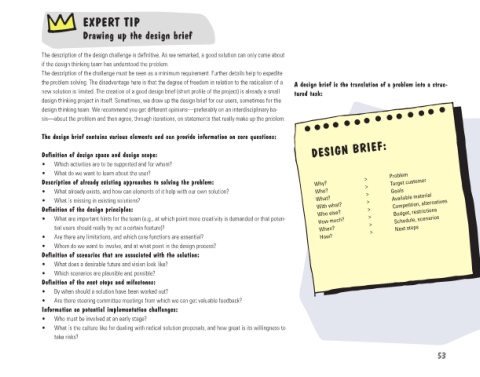
             the problem solving. The disadvantage here is that the degree of freedom in relation to the radicalism of a   A design brief is the translation of a problem into a struc-
             new solution is limited. The creation of a good design brief (short profile of the project) is already a small   tured task:
             design thinking project in itself. Sometimes, we draw up the design brief for our users, sometimes for the
             design thinking team. We recommend you get different opinions—preferably on an interdisciplinary ba-
             sis—about the problem and then agree, through iterations, on statements that really make up the problem.


             The design brief contains various elements and can provide information on core questions:
                                                                                          DESIGN BRIEF:
             Definition of design space and design scope:
             •   Which activities are to be supported and for whom?
             •   What do we want to learn about the user?                                                       Problem
             Description of already existing approaches to solving the problem:            Why?          > >     Target customer
             •   What already exists, and how can elements of it help with our own solution?  Who?        >      Goals
             •   What is missing in existing solutions?                                    What?          >      Available material
                                                                                                                 Competition, alternatives
             Definition of the design principles:                                           With what?    >       Budget, restrictions
                                                                                            Who else?
             •   What are important hints for the team (e.g., at which point more creativity is demanded or that poten-  How much?   >   Schedule, scenarios
                 tial users should really try out a certain feature)?                       When?          >  >   Next steps
             •   Are there any limitations, and which core functions are essential?          How?
             •   Whom do we want to involve, and at what point in the design process?
             Definition of scenarios that are associated with the solution:
             •   What does a desirable future and vision look like?
             •   Which scenarios are plausible and possible?
             Definition of the next steps and milestones:
             •   By when should a solution have been worked out?
             •   Are there steering committee meetings from which we can get valuable feedback?
             Information on potential implementation challenges:
             •   Who must be involved at an early stage?
             •   What is the culture like for dealing with radical solution proposals, and how great is its willingness to
                 take risks?
                                                                                                                              53

