


Page 52 - The Design Thinking Playbook
P. 52
PROBLEM


                       well-defined

                        Clear problem > different paths > one solution
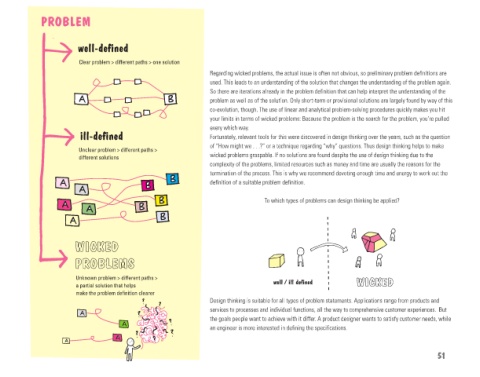
                                                             Regarding wicked problems, the actual issue is often not obvious, so preliminary problem definitions are
                                                             used. This leads to an understanding of the solution that changes the understanding of the problem again.
                                                             So there are iterations already in the problem definition that can help interpret the understanding of the
                                                             problem as well as of the solution. Only short-term or provisional solutions are largely found by way of this
                                                             co-evolution, though. The use of linear and analytical problem-solving procedures quickly makes you hit
                                                             your limits in terms of wicked problems: Because the problem is the search for the problem, you’re pulled
                                                             every which way.
                        ill-defined                          Fortunately, relevant tools for this were discovered in design thinking over the years, such as the question
                                                             of “How might we . . .?” or a technique regarding “why” questions. Thus design thinking helps to make
                        Unclear problem > different paths >
                        different solutions                  wicked problems graspable. If no solutions are found despite the use of design thinking due to the
                                                             complexity of the problems, limited resources such as money and time are usually the reasons for the
                                                             termination of the process. This is why we recommend devoting enough time and energy to work out the
                                                             definition of a suitable problem definition.

                                                                             To which types of problems can design thinking be applied?


                       Unknown problem > different paths >
                       a partial solution that helps                           well / ill defined
                       make the problem definition clearer
                                                             Design thinking is suitable for all types of problem statements. Applications range from products and
                                                             services to processes and individual functions, all the way to comprehensive customer experiences.  But
                                                             the goals people want to achieve with it differ. A product designer wants to satisfy customer needs, while
                                                             an engineer is more interested in defining the specifications.


                                                                                                                              51

