


Page 99 - The Design Thinking Playbook
P. 99
1.8 How to structure and select ideas


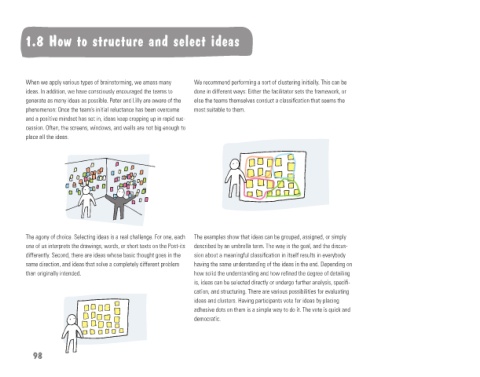
        When we apply various types of brainstorming, we amass many   We recommend performing a sort of clustering initially. This can be
        ideas. In addition, we have consciously encouraged the teams to   done in different ways: Either the facilitator sets the framework, or
        generate as many ideas as possible. Peter and Lilly are aware of the   else the teams themselves conduct a classification that seems the
        phenomenon: Once the team’s initial reluctance has been overcome   most suitable to them.
        and a positive mindset has set in, ideas keep cropping up in rapid suc-
        cession. Often, the screens, windows, and walls are not big enough to
        place all the ideas.


        The agony of choice. Selecting ideas is a real challenge. For one, each   The examples show that ideas can be grouped, assigned, or simply
        one of us interprets the drawings, words, or short texts on the Post-its   described by an umbrella term. The way is the goal, and the discus-
        differently. Second, there are ideas whose basic thought goes in the   sion about a meaningful classification in itself results in everybody
        same direction, and ideas that solve a completely different problem   having the same understanding of the ideas in the end. Depending on
        than originally intended.                       how solid the understanding and how refined the degree of detailing
                                                        is, ideas can be selected directly or undergo further analysis, specifi-
                                                        cation, and structuring. There are various possibilities for evaluating
                                                        ideas and clusters. Having participants vote for ideas by placing
                                                        adhesive dots on them is a simple way to do it. The vote is quick and
                                                        democratic.


          98

