


Page 95 - The Design Thinking Playbook
P. 95
HOW MIGHT WE...

                   generate depth when searching
                   for ideas?


        Depth of ideas                                                           4.  Idea variants (level 4)
        To explain the levels of the depth of ideas and the term “requirements” better, we use the following model:   Any number of variants can evolve for each of these ideas. In a sec-
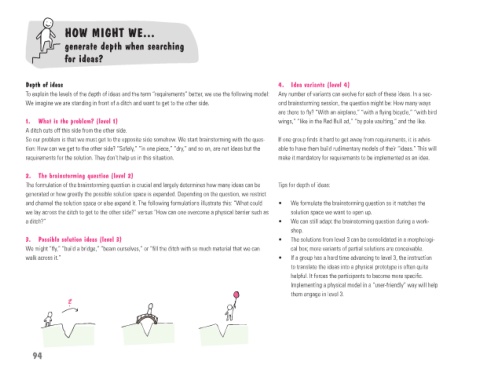
        We imagine we are standing in front of a ditch and want to get to the other side.  ond brainstorming session, the question might be: How many ways
                                                                                 are there to fly? “With an airplane,” “with a flying bicycle,” “with bird
        1.  What is the problem? (level 1)                                       wings,” “like in the Red Bull ad,” “by pole vaulting,” and the like.
        A ditch cuts off this side from the other side.
        So our problem is that we must get to the opposite side somehow. We start brainstorming with the ques-  If one group finds it hard to get away from requirements, it is advis-
        tion: How can we get to the other side? “Safely,” “in one piece,” “dry,” and so on, are not ideas but the   able to have them build rudimentary models of their “ideas.” This will
        requirements for the solution. They don’t help us in this situation.     make it mandatory for requirements to be implemented as an idea.

        2.  The brainstorming question (level 2)
        The formulation of the brainstorming question is crucial and largely determines how many ideas can be   Tips for depth of ideas:
        generated or how greatly the possible solution space is expanded. Depending on the question, we restrict
        and channel the solution space or else expand it. The following formulations illustrate this: “What could   •   We formulate the brainstorming question so it matches the
        we lay across the ditch to get to the other side?” versus “How can one overcome a physical barrier such as   solution space we want to open up.
        a ditch?”                                                                •   We can still adapt the brainstorming question during a work-
                                                                                    shop.
        3.  Possible solution ideas (level 3)                                    •   The solutions from level 3 can be consolidated in a morphologi-
        We might “fly,” “build a bridge,” “beam ourselves,” or “fill the ditch with so much material that we can   cal box; more variants of partial solutions are conceivable.
        walk across it.”                                                         •   If a group has a hard time advancing to level 3, the instruction
                                                                                    to translate the ideas into a physical prototype is often quite
                                                                                    helpful. It forces the participants to become more specific.
                                                                                    Implementing a physical model in a “user-friendly” way will help
                                                                                    them engage in level 3.


          94

