


Page 1084 - How to Make Money in Stocks Trilogy
P. 1084
70  HOW TO MAKE MONEY IN STOCKS—GETTING STARTED


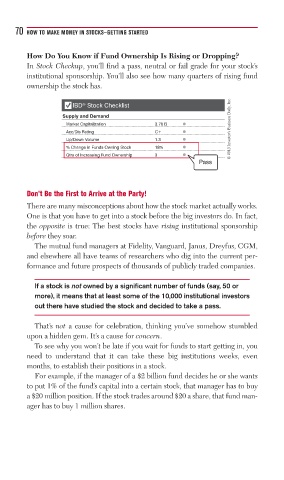
         How Do You Know if Fund Ownership Is Rising or Dropping?
         In Stock Checkup, you’ll find a pass, neutral or fail grade for your stock’s
         institutional sponsorship. You’ll also see how many quarters of rising fund
         ownership the stock has.
                                                                 © 2013 Investor’s Business Daily, Inc.
                     IBD  Stock Checklist
                        ®
                   Supply and Demand
                    Market Capitalization   3.70 B
                    Acc/Dis Rating          C
                    Up/Down Volume          1.3
                    % Change in Funds Owning Stock  18%
                    Qtrs of Increasing Fund Ownership  3
                                                         Pass


         Don’t Be the First to Arrive at the Party!
         There are many misconceptions about how the stock market actually works.
         One is that you have to get into a stock before the big investors do. In fact,
         the opposite is true: The best stocks have rising institutional sponsorship
         before they soar.
           The mutual fund managers at Fidelity, Vanguard, Janus, Dreyfus, CGM,
         and elsewhere all have teams of researchers who dig into the current per-
         formance and future prospects of thousands of publicly traded companies.


           If a stock is not owned by a significant number of funds (say, 50 or
           more), it means that at least some of the 10,000 institutional investors
           out there have studied the stock and decided to take a pass.

           That’s not a cause for celebration, thinking you’ve somehow stumbled
         upon a hidden gem. It’s a cause for concern.
           To see why you won’t be late if you wait for funds to start getting in, you
         need to understand that it can take these big institutions weeks, even
         months, to establish their positions in a stock.
           For example, if the manager of a $2 billion fund decides he or she wants
         to put 1% of the fund’s capital into a certain stock, that manager has to buy
         a $20 million position. If the stock trades around $20 a share, that fund man-
         ager has to buy 1 million shares.

