


Page 47 - TI Journal 18-1
P. 47
EVALUATION OF NEUROMODULATION USING MRI                         41


          to when at rest. Importantly, there are a number of   contact between the apparatus and the subject (74).
          studies that have shown that unique alterations in   Of note, the properties of cerebrospinal fluid and
          the DMN occur in patients with different disorders,   surface properties of the brain likely produce a wider
          including anxiety, depression, and acute/chronic pain   area of effect than the target location for stimulation
          (11,26,27). A preliminary study of healthy control   (89).
          participants indicated a significant change in the     TMS can be delivered through different techniques
          DMN and cortical deactivation, especially at the   (single, paired, and repeated) to produce either a
          higher frequency (100-Hz) CES stimulation (19).   disruptive, excitatory, or inhibitory effect on cortical
          These specific changes in the DMN and cortical acti-  function (74,89). The excitatory, or facilitative, effect
          vation patterns could lead to the therapeutic effects   on motor cortex was the rationale for repetitive TMS
          seen in clinical studies by altering thought patterns   (rTMS) treatment of depression. The facilitative effect
          (e.g., worry or rumination) and promoting attention   of TMS has been demonstrated to persist for days
          to other stimuli (e.g., surrounding environment).   to weeks following a series of rTMS treatments (87).
          However, these potential therapeutic effects remain   The inhibitory effect of TMS delivered to a specific
          speculative currently and require additional studies.   location has been extensively utilized in cognitive
            From this review of the literature, it is clear that   neuroscience to understand structural-functional
          CES has positive results in a number of different   relationships in the brain (74). In part because of
          clinical settings. The literature certainly could benefit   the ability to produce facilitative or inhibitory effects,
          from clinical trial methodologies (e.g., randomization,
          placebo, cross-over designs, etc.) and more direct
          observation of brain changes using advanced tech-
          nologies like MRI. Future studies will be important in
          not only helping to characterize the functional effects
          of CES and elucidate the biological underpinnings
          of CES efficacy, but may very well lead to improved
          methods CES treatment (e.g., better delivery, dosage
          requirements, improved target accuracy).

          Transcranial Magnetic Stimulation (TMS)
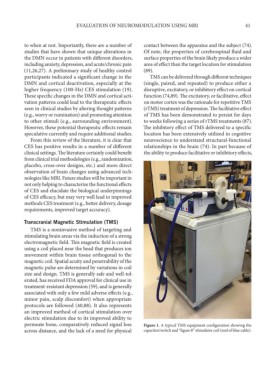
            TMS is a noninvasive method of targeting and
          stimulating brain areas via the induction of a strong
          electromagnetic field. This magnetic field is created
          using a coil placed near the head that produces ion
          movement within brain tissue orthogonal to the
          magnetic coil. Spatial acuity and penetrability of the
          magnetic pulse are determined by variations in coil
          size and design. TMS is generally safe and well-tol-
          erated, has received FDA approval for clinical use in
          treatment-resistant depression (59), and is generally
          associated with only a few mild adverse effects (e.g.,
          minor pain, scalp discomfort) when appropriate
          protocols are followed (40,88). It also represents
          an improved method of cortical stimulation over
          electric stimulation due to its improved ability to
          permeate bone, comparatively reduced signal loss   Figure 1. A typical TMS equipment configuration showing the
          across distance, and the lack of a need for physical   capacitor/switch and “figure 8” stimulator coil (end of blue cable).

