


Page 48 - TI Journal 18-1
P. 48
42                                       TATE


      research has focused on the potential of rTMS to
      alleviate symptoms associated with a wide range of
      neurological and psychiatric conditions, including
       schizophrenic hallucinations, tinnitus, anxiety, neu-
      rodegenerative disorders, and chronic pain (89)
        The use of MRI in combination with TMS has been
      the subject of significant interest (87). TMS can be
      delivered before, during, or after MRI. This flexibil-
      ity can be used to establish causality or correlations
       between imaging changes and behavior previously
      noted on MRI. Frameless stereotactic systems use
       structural MRI data to precisely deliver TMS in a
       specific location (75). While these multimodal studies
      increase specificity regarding focal brain targets for
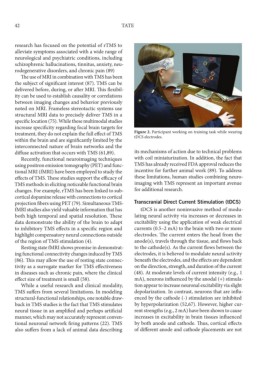
      treatment, they do not explain the full effect of TMS   Figure 2. Participant working on training task while wearing
      within the brain and are significantly limited by the   tDCS electrodes.
      interconnected nature of brain networks and the
      diffuse activation that occurs with TMS (61,89).  its mechanisms of action due to technical problems
        Recently, functional neuroimaging techniques   with coil miniaturization. In addition, the fact that
      using positron emission tomography (PET) and func-  TMS has already received FDA approval reduces the
      tional MRI (fMRI) have been employed to study the   incentive for further animal work (89). To address
      effects of TMS. These studies support the efficacy of   these limitations, human studies combining neuro-
      TMS methods in eliciting noticeable functional brain   imaging with TMS represent an important avenue
      changes. For example, rTMS has been linked to sub-  for additional research.
      cortical dopamine release with connections to cortical
      projection fibers using PET (79). Simultaneous TMS-  Transcranial Direct Current Stimulation (tDCS)
      fMRI studies also yield valuable information that has     tDCS is another noninvasive method of modu-
       both high temporal and spatial resolution. These   lating neural activity via increases or decreases in
      data demonstrate the ability of the brain to adapt   excitability using the application of weak electrical
      to inhibitory TMS effects in a specific region and   currents (0.5–2 mA) to the brain with two or more
      highlight compensatory neural connections outside   electrodes. The current enters the head from the
      of the region of TMS stimulation (4).         anode(s), travels through the tissue, and flows back
        Resting state fMRI shows promise in demonstrat-  to the cathode(s). As the current flows between the
      ing functional connectivity changes induced by TMS   electrodes, it is believed to modulate neural activity
      (86). This may allow the use of resting state connec-  beneath the electrodes, and the effects are dependent
      tivity as a surrogate marker for TMS effectiveness   on the direction, strength, and duration of the current
      in diseases such as chronic pain, where the clinical   (48). At moderate levels of current intensity (e.g., 1
      effect size of treatment is small (58).       mA), neurons influenced by the anodal (+) stimula-
        While a useful research and clinical modality,   tion appear to increase neuronal excitability via slight
      TMS suffers from several limitations. In modeling   depolarization. In contrast, neurons that are influ-
       structural-functional relationships, one notable draw-  enced by the cathode (-) stimulation are inhibited
       back in TMS studies is the fact that TMS stimulates   by hyperpolarization (52,67). However, higher cur-
      neural tissue in an amplified and perhaps artificial   rent strengths (e.g., 2 mA) have been shown to cause
      manner, which may not accurately represent conven-  increases in excitability in brain tissues influenced
      tional neuronal network firing patterns (22). TMS   by both anode and cathode. Thus, cortical effects
      also suffers from a lack of animal data describing   of different anode and cathode placements are not

