


Page 62 - T-I JOURNAL19 4
P. 62
710 DEMIRALP ET AL. WOMEN’S ENTREPRENEURSHIP IN STEM 711
Table 1. Break-down of the Employed Population (2015 ACS)
Women
juxtaposition of the two classifications for business 2012 SBO data is available only in aggregate form, Table 1. Break-down of the Employed Population (2015 ACS) Men
owners: those who identify as self-employed based which requires the analysis to be based on the stan- Count Women Percentage Count Men Percentage
100%
100%
on the job at which they work the highest number dard majority ownership definition. Employed 71,657,044 Percentage 79,936,236 Percentage
Count
Count
of hours, as identified through use of the ACS, and Wage/Salary Employment 66,456,749 92.7% 70,911,908 88.7%
100%
71,657,044
79,936,236
100%
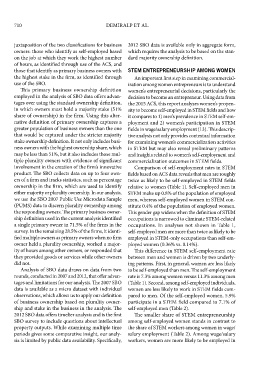
those that identify as primary business owners with STEM ENTREPRENEURSHIP AMONG WOMEN Employed 9,609,195 13.4% 8,538,726 10.7%
STEM
Non-STEM
the highest stake in the firm, as identified through An important first step in examining commercial- Wage/Salary Employment 66,456,749 92.7% 70,911,908 88.7%
62,373,182
79.3%
56,847,554
78.0%
use of the SBO. ization among women entrepreneurs is to understand STEM 9,609,195 13.4% 8,538,726 10.7%
7.3%
Self-Employment
9,024,328
11.3%
5,200,295
This primary business ownership definition women’s entrepreneurial decisions, particularly the Non-STEM 56,847,554 79.3% 62,373,182 78.0%
644,230
0.8%
307,753
0.4%
STEM
employed in the analysis of SBO data offers advan- decision to become an entrepreneur. Using data from Self-Employment 5,200,295 7.3% 9,024,328 11.3%
4,892,542
8,380,098
6.8%
10.5%
Non-STEM
tages over using the standard ownership definition, the 2015 ACS, this report analyzes women’s propen- STEM 307,753 0.4% 644,230 0.8%
in which owners must hold a majority stake (51% sity to become self-employed in STEM fields and how Source: Authors’ analysis of 2015 American Community Survey obtained from the IPUMS-USA database. 10.5%
4,892,542
Non-STEM
8,380,098
6.8%
share of ownership) in the firm. Using this alter- it compares to 1) men’s prevalence in STEM self-em- Note: STEM fields are defined based on occupation codes and include the following: Computer and Mathematical
Occupations, Architecture and Engineering Occupations, Life and Physical Sciences Occupations, Health
native definition of primary ownership captures a ployment and 2) women’s participation in STEM Source: Authors’ analysis of 2015 American Community Survey obtained from the IPUMS-USA database.
Note: STEM fields are defined based on occupation codes and include the following: Computer and Mathematical
greater population of business owners than the one fields in wage/salary employment (13). This descrip- Occupations.
that would be captured under the stricter majority tive analysis not only provides contextual information Occupations, Architecture and Engineering Occupations, Life and Physical Sciences Occupations, Health
Occupations.
stake ownership definition. It not only includes busi- for examining women’s commercialization activities
ness owners with the highest ownership share, which in STEM but may also reveal preliminary patterns Table 2. Share of STEM in the Employed Population (2015 ACS)
may be less than 51%, but it also includes those mul- and insights related to women’s self-employment and
tiple plurality owners with evidence of significant commercialization outcomes in STEM fields. Table 2. Share of STEM in the Employed Population (2015 ACS) Women Men
involvement in the creation of the firm’s innovative Comparison of self-employment rates in STEM Self-Employed (Total Count) 5,200,295 9,024,328
Men
product. The SBO collects data on up to four own- fields based on ACS data reveals that men are roughly STEM Women 7.1%
5.9%
ers of a firm and tracks statistics, such as percentage twice as likely to be self-employed in STEM fields Self-Employed (Total Count) 5,200,295 9,024,328
94.1%
92.9%
Non-STEM
7.1%
5.9%
STEM
ownership in the firm, which are used to identify relative to women (Table 1). Self-employed men in Wage/Salary Workers (Total Count) 66,456,749 70,911,908
either majority or plurality ownership. In our analysis, STEM make up 0.8% of the population of employed Non-STEM 94.1% 92.9%
12.0%
14.5%
STEM
we use the SBO 2007 Public Use Microdata Sample men, whereas self-employed women in STEM con- Wage/Salary Workers (Total Count) 66,456,749 70,911,908
(PUMS) data to discern plurality ownership among stitute 0.4% of the population of employed women. Non-STEM 85.5% 88.0%
14.5%
12.0%
STEM
the responding owners. The primary business owner- This gender gap widens when the definition of STEM Source: Authors’ analysis of 2015 American Community Survey obtained from the IPUMS-USA database. 88.0%
Non-STEM
85.5%
ship definition used in the current analysis identified occupations is narrowed to eliminate STEM-related Note: STEM fields are defined based on occupation codes and include the following: Computer and Mathematical
Occupations, Architecture and Engineering Occupations, Life and Physical Sciences Occupations, Health
a single primary owner in 71.5% of the firms in the occupations. In analyses not shown in Table 1, Source: Authors’ analysis of 2015 American Community Survey obtained from the IPUMS-USA database.
survey. In the remaining 28.5% of the firms, it identi- self-employed men are more than twice as likely to be Occupations.
Note: STEM fields are defined based on occupation codes and include the following: Computer and Mathematical
fied multiple owners as primary owners when no firm employed in STEM-only occupations than self-em- Occupations, Architecture and Engineering Occupations, Life and Physical Sciences Occupations, Health
Occupations.
owner held a plurality ownership, worked a major- ployed women (0.36% vs. 0.14%). a STEM field (14.5%) compared to men (12%). The Distribution of entrepreneurship across STEM
ity of hours among other owners, or responded that This difference in STEM self-employment rate observation that, relative to men, women in wage/sal- occupations varies between men and women, sug-
Table 3. Distribution of STEM Entrepreneurship across STEM Fields (2015 ACS)
they provided goods or services while other owners between men and women is driven by two underly- ary employment have greater participation in STEM gesting that both internal motivations and external
did not. ing patterns. First, in general, women are less likely and self-employed women have lower participation forces may encourage women’s entrepreneurship to
Table 3. Distribution of STEM Entrepreneurship across STEM Fields (2015 ACS)
Analysis of SBO data draws on data from two to be self-employed than men. The self-employment in STEM may be indicative of the barriers women in a greater extent in certain STEM fields (Table 3). Women Men
rounds, conducted in 2007 and 2012, that offer advan- rate is 7.3% among women versus 11.3% among men STEM face in entering self-employment. Specifically, Women who choose to be self-employed in STEM
Men
Women
307,753
644,230
Self-employed in STEM (Total Count)
tages and limitations for our analysis. The 2007 SBO (Table 1). Second, among self-employed individuals, women in STEM may face different challenges than occupations work predominantly in health occupa-
Computer and Mathematical Occupations (e.g., computer
data is available as a micro dataset with individual women are less likely to work in STEM fields com- those faced by women in non-STEM fields in enter- tions (e.g., physicians, dentists, physical therapists,
Self-employed in STEM (Total Count)
307,753
644,230
26.1%
programmers, web developers, operations research analysts)
13.1%
observations, which allows us to apply our definition pared to men. Of the self-employed women, 5.9% ing entrepreneurship, or their entrepreneurial opticians) (77.8%). The distribution of the self-em-
Computer and Mathematical Occupations (e.g., computer
of business ownership based on plurality owner- participate in a STEM field compared to 7.1% of decisions may be more sensitive to certain determi- ployed women population across the remaining
programmers, web developers, operations research analysts)
13.1%
26.1%
18.2%
6.7%
Architecture and Engineering Occupations
ship and stake in the business in the analysis. The self-employed men (Table 2). nants of entrepreneurship compared to women in STEM occupations varies substantially, with 13.1%
Life and Physical Sciences Occupations (e.g., physical scientists,
2012 SBO data offers timelier analysis and is the first The smaller share of STEM entrepreneurship other fields. Identifying the unique determinants of in computer and mathematical occupations, 6.7% in
6.7%
18.2%
Architecture and Engineering Occupations
3.1%
2.4%
chemist and material scientists, biological scientists)
SBO survey to include questions about intellectual among self-employed women stands in contrast to STEM entrepreneurship among women or factors architecture and engineering, and 2.4% in life and
Life and Physical Sciences Occupations (e.g., physical scientists,
Health Occupations (e.g., physicians and surgeons, registered
property outputs. While examining multiple time the share of STEM workers among women in wage/ that disproportionately affect STEM entrepreneur- physical sciences occupations. 3.1%
2.4%
chemist and material scientists, biological scientists)
52.6%
77.8%
nurses, clinical laboratory technologists and technicians)
periods gives some comparative insight, our analy- salary employment (Table 2). Among wage/salary ship is an important research goal that would provide While these general patterns hold for self-em-
Health Occupations (e.g., physicians and surgeons, registered
sis is limited by public data availability. Specifically, workers, women are more likely to be employed in key insights for policy-making. ployed men in STEM fields, there are differences in
nurses, clinical laboratory technologists and technicians) 77.8% 52.6%
100%
TOTAL %
100%
Source: Authors’ analysis of 2015 American Community Survey obtained from the IPUMS-USA database.
TOTAL % 100% 100%
Note: STEM fields are defined based on occupation codes and include the following: Computer and Mathematical
Source: Authors’ analysis of 2015 American Community Survey obtained from the IPUMS-USA database.
Occupations, Architecture and Engineering Occupations, Life and Physical Sciences Occupations, Health
Occupations.
Note: STEM fields are defined based on occupation codes and include the following: Computer and Mathematical
Occupations, Architecture and Engineering Occupations, Life and Physical Sciences Occupations, Health
Occupations.

