


Page 67 - T-I JOURNAL19 4
P. 67
714   DEMIRALP ET AL.               WOMEN’S ENTREPRENEURSHIP IN STEM                        715


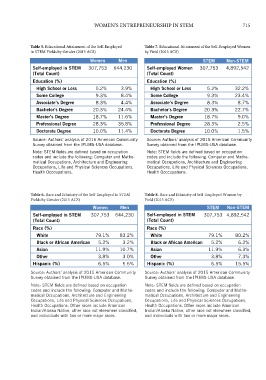
 STEM educations do not, on average, attain equally  in STEM (57.0% vs. 58.8%), it varies across different   Table 5. Educational Attainment of the Self-Employed   Table 7. Educational Attainment of the Self-Employed Women
 high degrees as men. For example, men receive more  graduate degrees (Table 5). Women who are self-em-  in STEM Fields by Gender (2015 ACS)  by Field (2015 ACS)
 STEM or STEM-related doctoral degrees than women  ployed in STEM are more likely to hold a master’s   Wome  n  Men  STEM    Non-STEM
 (16). Women who complete STEM degrees are also  degree relative to self-employed men in STEM.
 less likely than men to work in careers or sectors that  However, they are less likely to hold a professional   Self-employed in STEM  307,753  644,230  Self-employed Women  307,753  4,892,542
                                                         (Total Count)
             (Total Count)
 draw on STEM-relevant skill sets (3).   or doctoral degree compared to self-employed men
   Among students of color, the lower prevalence  in STEM. Furthermore, bachelor’s degrees are less   Education (%)   Education (%)
 of women pursuing STEM education is even more  prevalent and high school and associate’s degrees are   High School or Less    5.2%  3.9%  High School or Less    5.2%  32.2%
 marked and may represent a critical area of underuti-  more prevalent among self-employed women rela-  Some College    9.3%  8.4%  Some College    9.3%  23.4%
 lized human capital. Ong et al. argue that explanations  tive to self-employed men in STEM.   Associate’s Degree    8.3%  4.4%  Associate’s Degree    8.3%  8.7%
 for the extant under-representation of women of    The results also show that self-employed women   Bachelor’s Degree    20.3%  24.4%  Bachelor’s Degree    20.3%  22.7%
 color in STEM too often rely on the false notion  in STEM are more likely to be non-white compared   Master’s Degree    18.7%  11.6%  Master’s Degree    18.7%  9.0%
 that minority women are not interested in STEM  to men who are self-employed in STEM (20.9% vs.   Professional Degree    28.3%  35.8%  Professional Degree    28.3%  2.5%
 educations and careers (17). An examination of  16.8%) (Table 6). Asians make up the largest non-
 undergraduate women of color in STEM fields argues  white group among both women and men who are   Doctorate Degree    10.0%  11.4%  Doctorate Degree    10.0%  1.5%
 that minority women students are more likely to  self-employed in STEM (11.9% and 10.7%). Women   Source: Authors’ analysis of 2015 American Community  Source: Authors’ analysis of 2015 American Community
 complete STEM majors when external assurances  who are self-employed in STEM fields are also more   Survey obtained from the IPUMS-USA database.  Survey obtained from the IPUMS-USA database.


 are present; specifically, degree completion increases  likely to be black or African American (5.2% vs.   Note: STEM fields are defined based on occupation  Note: STEM fields are defined based on occupation
 when minority women students have a supportive  3.2%) or other race (3.8% vs. 3.0%) relative to men.   codes and include the following: Computer and Mathe-  codes and include the following: Computer and Mathe-
                                                         matical Occupations, Architecture and Engineering
             matical Occupations, Architecture and Engineering
 collegiate environment, strong academic peer rela-  Furthermore, a greater percentage of self-employed   Occupations, Life and Physical Sciences Occupations,  Occupations, Life and Physical Sciences Occupations,
 tionships, and research program involvement (18).  women in STEM are Hispanic relative to men (6.5%   Health Occcupations.  Health Occcupations.
 Examining female African American students specif-  vs. 5.5%).
 ically, few programs that promote the psychological      Compared to self-employed women in non-STEM
 readiness of students or preparedness to conduct  fields, self-employed women in STEM fields are older
 research in non-minority-dominated fields have been  (49 vs. 48) and more likely to be married (67% vs.   Table 6. Race and Ethnicity of the Self-Employed in STEM  Table 8. Race and Ethnicity of Self-Employed Women by
                                                        Field (2015 ACS)
             Fields by Gender (2015 ACS)
 demonstrated to be effective (19).   61%). As explained above, however, the average age

 and likelihood to be married among self-employed   Wom  en  Men               STEM    Non-STEM
 OWNER CHARACTERISTICS OF WOMEN-  women in STEM is lower than that for self-employed   Self-employed in STEM  307,753  644,230  Self-employed in STEM  307,753 4,892,542
 OWNED STEM BUSINESSES  men in STEM. The analysis results reveal large dif-  (Total Count)  (Total Count)
   This section presents results from the analysis of   ferences between STEM and non-STEM women   Race (%)     Race (%)
 2015 ACS and 2007 SBO data to examine the char-  entrepreneurs in terms of educational attainment   White     79.1%  83.2%  White  79.1%  80.2%
 acteristics of business owners across genders and   (Table 7). The majority of self-employed women in   Black or African American  5.2%  3.2%  Black or African American  5.2%  6.2%


 STEM and non-STEM fields. The analysis is aimed   STEM fields (57%) have a graduate degree, while   Asian     11.9%  10.7%  Asian  11.9%  6.3%
 to provide insight into the potential factors associ-  13% of self-employed women in non-STEM fields   Other     3.8%  3.0%  Other  3.8%  7.3%
 ated with STEM entrepreneurship among women.   have a similar degree. In contrast, more than half of   Hispanic (%)       6.5%  5.5%  Hispanic (%)  6.5%  15.5%
 self-employed women in non-STEM fields have at


 American Community Survey Analysis Results  most a high school degree (including some college)   Source: Authors’ analysis of 2015 American Community  Source: Authors’ analysis of 2015 American Community
   The analysis of 2015 ACS data reveals differences  (55.6%), while only 14.45% of self-employed women   Survey obtained from the IPUMS-USA database.  Survey obtained from the IPUMS-USA database.
 between self-employed men and women in STEM as  in STEM fields have similar educational attainment.   Note: STEM fields are defined based on occupation  Note: STEM fields are defined based on occupation
 well as between self-employed women in STEM and  These findings underscore the important role that   codes and include the following: Computer and Mathe-  codes and include the following: Computer and Mathe-
 non-STEM fields. First, the results show that self-em-  higher education plays in STEM entrepreneurship.  matical Occupations, Architecture and Engineering  matical Occupations, Architecture and Engineering
                                                        Occupations, Life and Physical Sciences Occupations,
             Occupations, Life and Physical Sciences Occupations,
 ployed women in STEM are slightly younger than    Racial distribution of self-employed women in   Health Occupations. Other races include American  Health Occupations. Other races include American
 self-employed men in STEM (49 vs. 52). Second, they  STEM and non-STEM fields reveals that the preva-  Indian/Alaska Native, other race not elsewhere classified,  Indian/Alaska Native, other race not elsewhere classified,
 are less likely to be married compared to self-em-  lence of minority entrepreneurship is similar in both   and individuals with two or more major races.  and individuals with two or more major races.
 ployed men in STEM (67% vs. 76%).   groups (Table 8). Among self-employed women in
   While the frequency of graduate degree holders  STEM, 20.9% are likely to be non-white compared to
 is similar between self-employed men and women  19.8% among self-employed women in non-STEM

