


Page 70 - T-I JOURNAL19 4
P. 70
718                                DEMIRALP ET AL.                                                                                 WOMEN’S ENTREPRENEURSHIP IN STEM                         719


      Table 11. Characteristics of Businesses: Business Performance by Owner Gender and STEM Status (2007 SBO)   and commercialization may further explain existing  precursors as well as critical outputs of commercial-
                                                                                                                 gender gaps, as the disparity is quite marked, par-  ization behaviors. The findings are additionally robust
                                   Female-owned    Male-owned   Female-owned    Male-owned
                                          STEM          STEM       non-STEM      non-STEM                        ticularly among women-owned firms in STEM. The  to changes in the definition of primary business own-
       N                              1,360,550     2,761,549     6,681,528    11,708,507                        majority of all respondent businesses rely on less than  ership. A comparison of the findings to results under
                                                                                                                                                            traditional definitions of majority ownership applied
                                                                                                                 $5,000 in start-up capital, the lowest funding cate-
       No. employee (average)               1.1           3.1           1.0           2.7                        gory included in the survey questionnaire; however,  to 2007 and 2012 SBO data (in analyses not shown)
       Payroll ($1000, average)            40.5         135.0          24.7          86.1                        women-owned single-owner businesses in STEM are  demonstrates that, across the plurality and majority
       Receipts ($1000, average)          176.3         574.3         144.4         536.5                        most likely to rely on this funding category (Figure  owner definitions and survey rounds, characteris-
       Number of years in operation                                                                              1). Men-owned firms are more likely to use higher  tics of business owners and businesses are broadly
         Not reported                     4.5%          3.4%          6.3%           5.0%                        levels of start-up funding slightly more often than  similar. While variation in owner definition by sur-
         Less than 1                     13.6%         10.3%         12.7%           9.3%                        women-owned firms in both STEM and non-STEM  vey year introduces some minor changes in the size
         1                                8.8%          6.9%          8.4%           6.5%                        firms. At start-up funding levels above $5,000, the  of gender and sector disparities along certain indi-
          2 to 4                         17.6%         15.4%         17.3%          15.1%                        disparity in funding by gender becomes apparent.  cators, trends remain very similar.
          5 to 17                        32.3%         32.8%         28.6%          30.2%                        Among STEM and non-STEM men-owned firms,
         More than 18                    15.0%         25.1%         16.0%          25.9%                        non-STEM firms are more likely to receive start-up  COMMERCIALIZATION AMONG WOMEN-
                                                                                                                 funding at all higher levels of funding than STEM  OWNED STEM BUSINESSES
       Source: Authors’ own analysis of 2007 Survey of Business Owners (U.S. Census Bureau)
                                                                                                                 firms. Among female owners, STEM firms see the    Using data from the 2012 Survey of Business
       Note: Firms operating in STEM fields are identified using two digit NAICS codes representing industries in which  gap in likelihood to receive start-up funding most  Owners, the report also examines a firm’s intellec-
       STEM occupations make up 5.8% (national average) of total employment.                                     markedly from all other firm owners beginning at  tual property ownership as an important indicator
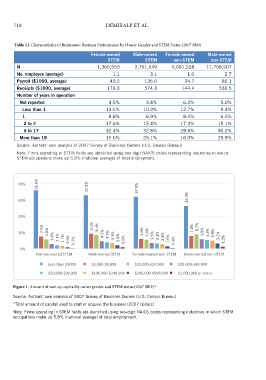
       Figure 1. Amount of start-up capital by owner gender and STEM status (2007 SBO). *                        the $100,000 to $249,999 level, while the gap emerges  of commercialization behavior. The analysis takes
                                                                                                                 prominently for women-owned non-STEM busi-  into account the behavior of filing and receiving

        40%    36.0%              32.8%              32.0%                                                       nesses at the $250,000 to $999,999 funding level.  intellectual property as the first critical step in the
                                                                                                                   Start-up funding sources, to some degree, also
                                                                                                                                                            commercialization process, which is followed by the
                                                                                                                 highlight disparities between men- and wom-
                                                                                                                                                            licensing of proprietary innovations. Thus, the anal-
        30%                                                             26.3%                                    en-owned businesses. Men-owned businesses, in  ysis results presented below characterize the role of
                                                                                                                 STEM and non-STEM fields, are consistently more  gender in a key initial phase of commercialization.
                                                                                                                 likely to rely on or gain access to a bank loan to fund    The commercialization-focused analysis draws
        20%                                                                                                      start-ups than women-owned businesses (Table 12).  on 2012 SBO data and the same approach to identi-
                 7.5%               9.2%   8.4%                           7.8%   8.7%                            This is notable, as bank loans typically give advan-  fying STEM fields by two-digit NAICS codes as the
                                                                                                                 tages over other personal funding sources, such as  one used in analyzing 2007 SBO data. However, to
        10%        5.6%   2.8%   2.1%   1.7%   0.9%   0.2%   4.5%   4.0%   3.3%   2.0%   0.9%   5.9%   5.4%   3.5%   3.1%   2.8%   1.6%   0.4%   5.8%   5.3%   4.9%   3.2%   1.2%   credit cards or personal loans, in that they are asso-  define the gender of firm owner, a Census Bureau

         0%                                                                                                      ciated with lower interest rates and lower personal  classification that identifies the owner as an indi-
                                                                                                                 financial risk. Expansion capital sources further high-
                                                                                                                                                            vidual holding at least 51% of the firm is adopted. In
               Female-owned STEM   Male-owned STEM   Female-owned non-STEM   Male-owned non-STEM
                                                                                                                 light the gender disparity in access to bank loans, as  firms where no individual majority owner is identi-
                       Less than $5000        $5,000-$9,999        $10,000-$24,999        $25,000-$49,999        men-owned firms, in STEM and non-STEM fields,  fiable, firms are classified as equal-ownership. SBO
                                                                                                                 use bank loans to finance expansion at more than  data further identifies firms that hold at least one
                       $50,000-$99,999        $100,000-$249,999        $250,000-$999,999        $1,000,000 or more   twice the rate of women-owned firms. Men-owned  piece of a type of intellectual property (e.g., trade-

       Source: Authors’ own analysis of 2007 Survey of Business Owners (U.S. Census Bureau)                      firms in both STEM and non-STEM fields are addi-  mark, patent) but does not provide information on
      Figure 1. Amount of start-up capital by owner gender and STEM status (2007 SBO).*                          tionally more likely to use business profits to fund  the intensity of intellectual property production (e.g.,

      Source: Authors’ own analysis of 2007 Survey of Business Owners (U.S. Census Bureau)                       expansion than women-owned firms; however, STEM  number of patents held by a single firm.) Table 13
       * Total amount of capital used to start or acquire the business (2007 dollars)
      *Total amount of capital used to start or acquire the business (2007 dollars)                              firms, broadly, are more likely to use business prof-  summarizes the trends in intellectual property out-

                                                                                                                 its to expand than non-STEM firms.
                                                                                                                                                            puts of STEM and non-STEM firms.
       Note: Firms operating in STEM fields are identified using two-digit NAICS codes representing
      Note: Firms operating in STEM fields are identified using two-digit NAICS codes representing industries in which STEM     The analyses presented here, while descriptive,    In all measures of commercial licensing (e.g.,
      occupations make up 5.8% (national average) of total employment.                                           yield insights that support findings from the litera-  patenting, trademarking, copyrighting) a distinct
       industries in which STEM occupations make up 5.8% (national average) of total employment.
                                                                                                                 ture, which identify a significant gender gap among  gender gap exists among STEM firms. Accordingly,
                                                                                                                 factors influencing participation in STEM educa-  men-owned firms are significantly more likely to
                                                                                                                 tion and entrepreneurship and experience-based  hold at least one piece of intellectual property than


                                                                                         8

