


Page 27 - Technology and Innovation Journal - 19-1
P. 27
ADAPTING STAGE-GATE TO MTM CURRICULUM                      365


             enter the Stage-Gate system. Elements such as voice  steps called “stages.” The process begins with a dis-
             of the customer (VOC) research, spiral or iterative  covery stage and ends with the post-launch review.
             development, sharp definition of the value proposi-  Typical stages in this process are as follows:
             tion, and open innovation or design thinking have   0) Discovery/ideation: Dedicated to the project ini-
             been integrated into the modern Stage-Gate systems   tiation and idea screening
             (7).                                       1) Scoping: Opportunity and risk analysis
               The Stage-Gate process is of great value in particu-  2) Feasibility: Technical feasibility and business case
             lar for the medical industry (8). The medical product  3) Full development: Design verification and vali-
             development process has become progressively com-  dation
             plex in recent years. The arrival of new technology  4) Scale-up and launch preparation: Final validation
             concepts, stricter regulatory requirements, and the  to product launch preparation
             ever-increasing importance of reimbursement deci-  5) Launch: Product launch and post-launch assess-
             sions for successful device commercialization require  ment
             careful planning and strategy-setting, coordinated   Each stage is designed to gather information to
             decisions, and consistent, rigorous business processes.   reduce key project uncertainties and risks. Each
             Study results suggest that Stage-Gate processes are   stage typically costs more than the preceding one.
             the predominant development model used in the   The process is one of incremental commitments and
             medical device industry (8).               a series of increasing investments. But, with each
                                                        stage and step-increase in project cost, the unknowns
             Application of the Stage-Gate Process      and uncertainties are driven down so that risk is
               When applying Stage-Gate, complex medical   effectively managed (1). A cross-functional and mul-
             product development is viewed as a process, which  tidisciplinary team is assigned to each stage, resulting
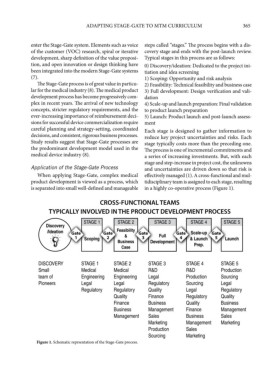
             is separated into small well-defined and manageable  in a highly co-operative process (Figure 1).

                                       CROSS-FUNCTIONAL TEAMS
                   TYPICALLY INVOLVED IN THE PRODUCT DEVELOPMENT PROCESS

                                 STAGE 1      STAGE 2      STAGE 3       STAGE 4      STAGE 5
                  Discovery
                   /Ideation  Gate      Gate  Feasibility  Gate     Gate  Scale-up  Gate
                             1   Scoping  2     &      3     Full    4   & Launch  5  Launch
                                              Business    Development      Prep.
                                               Case


               DISCOVERY        STAGE 1     STAGE 2      STAGE 3        STAGE 4      STAGE 5
               Small            Medical     Medical      R&D            R&D          Production
               team of          Engineering  Engineering  Legal         Production   Sourcing
               Pioneers         Legal       Legal        Regulatory     Sourcing     Legal
                                Regulatory  Regulatory   Quality        Legal        Regulatory
                                            Quality      Finance        Regulatory   Quality
                                            Finance      Business       Quality      Business
                                            Business     Management     Finance      Management
                                            Management   Sales          Business     Sales
                                                         Marketing      Management   Marketing
                                                         Production     Sales
                                                         Sourcing       Marketing
               Figure 1. Schematic reprsentation of the Stage-Gate process.

