


Page 30 - Technology and Innovation Journal - 19-1
P. 30
368                              DOMSCHKE & BLAHO


           was named ELBONIX and was theoretically   multidisciplinary course material in the context of
           envisioned to rank amongst the top 200 big-   a real-life, early-stage medical product development
           gest companies. This fictional company setting    process. Stage-Gate provides a clear structure defined
           offered students the opportunity to work with    by the stage activities and gate deliverables assigned to
           the Stage-Gate tool in the role of junior leader-   each discipline, which form the basis for the commu-
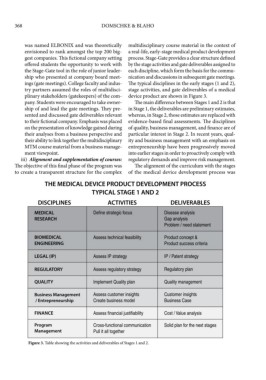
           ship who presented at company board meet-   nication and discussions in subsequent gate meetings.
           ings (gate meetings). College faculty and indus-  The typical disciplines in the early stages (1 and 2),
           try partners assumed the roles of multidisci-   stage activities, and gate deliverables of a medical
           plinary stakeholders (gatekeepers) of the com-   device product are shown in Figure 3.
           pany. Students were encouraged to take owner-     The main difference between Stages 1 and 2 is that
           ship of and lead the gate meetings. They pre-   in Stage 1, the deliverables are preliminary estimates,
           sented and discussed gate deliverables relevant    whereas, in Stage 2, those estimates are replaced with
           to their fictional company. Emphasis was placed   evidence-based final assessments. The disciplines
           on the presentation of knowledge gained during   of quality, business management, and finance are of
           their analyses from a business perspective and    particular interest in Stage 2. In recent years, qual-
           their ability to link together the multidisciplinary   ity and business management with an emphasis on
           MTM course material from a business manage-  entrepreneurship have been progressively moved
           ment viewpoint.                        into earlier stages in order to proactively comply with
        iii)  Alignment and supplementation of courses:   regulatory demands and improve risk management.
      The objective of this final phase of the program was     The alignment of the curriculum with the stages
      to create a transparent structure for the complex   of the medical device development process was

                  THE MEDICAL DEVICE PRODUCT DEVELOPMENT PROCESS
                                    TYPICAL STAGE 1 AND 2

               DISCIPLINES                ACTIVITIES              DELIVERABLES

              MEDICAL               Define strategic focus     Disease analysis
              RESEARCH                                         Gap analysis
                                                               Problem / need statement

              BIOMEDICAL            Assess technical feasibility  Product concept &
              ENGINEERING                                      Product success criteria

              LEGAL (IP)            Assess IP strategy         IP / Patent strategy

              REGULATORY            Assess regulatory strategy  Regulatory plan

              QUALITY               Implement Quality plan     Quality management

              Business Management   Assess customer insights   Customer insights
               / Entrepreneurship   Create business model      Business Case


              FINANCE               Assess financial justifiability  Cost / Value analysis
              Program               Cross-functional communication  Solid plan for the next stages
              Management            Pull it all together

            Figure 3. Table showing the activities and deliverables of Stages 1 and 2.

