


Page 29 - Technology and Innovation Journal - 19-1
P. 29
ADAPTING STAGE-GATE TO MTM CURRICULUM                      367


                 company growth and the different needs in each      tion of customer needs (techniques and meth-
                 growth phase, which create different work envi-     ods), VOC in the Stage-Gate process, and the
                 ronments and career opportunities, were discussed.      anatomy of a concept.
                 Additional topics included product life cycles    • Navigating the Complex Product Development
                 and the creation of short-, mid-, and long-term     Process: The Stage-Gate Paradigm: Creel’s sec-
                 product portfolios.                        ond lecture covered organizational consid-
                                                            erations, investment decisions, the Stage-Gate
               • Individual Student Mentor Sessions: Domschke’s      process, the “front end” of innovation, and
                 one-on-one student mentor sessions were held      evolved Stage-Gate.
                 each month throughout the program to help
                 students explore their own talents and true inter-    ii) Integration of the Stage Gate process into the
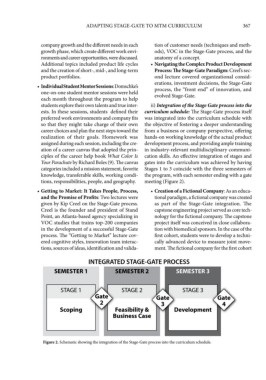
                 ests. In these sessions, students  defined their    curriculum schedule: The Stage-Gate process itself
                 preferred work environments and company fits   was integrated into the curriculum schedule with
                 so that they might take charge of their own   the objective of fostering a deeper understanding
                 career choices and plan the next steps toward the   from a business or company perspective, offering
                 realization of their goals. Homework was   hands-on working knowledge of the actual product
                 assigned during each session, including the cre-  development process, and providing ample training
                 ation of a career canvas that adopted the prin-   in industry-relevant multidisciplinary communi-
                 ciples of the career help book What Color Is   cation skills. An effective integration of stages and
                 Your Parachute by Richard Boles (9). The canvas   gates into the curriculum was achieved by having
                 categories included a mission statement, favorite   Stages 1 to 3 coincide with the three semesters of
                 knowledge, transferable skills, working condi-   the program, with each semester ending with a gate
                 tions, responsibilities, people, and geography.  meeting (Figure 2).
               • Getting to Market: It Takes People, Process,    • Creation of a Fictional Company: As an educa-
                 and the Promise of Profits: Two lectures were      tional paradigm, a fictional company was created
                 given by Kip Creel on the Stage-Gate process.      as part of the Stage-Gate integration. The
                 Creel is the founder and president of Stand     capstone engineering project served as core tech-
                 Point, an Atlanta-based agency specializing in      nology for the fictional company. The capstone
                 VOC studies that trains top-200 companies      project itself was conceived in close collabora-
                 in the development of a successful Stage-Gate      tion with biomedical sponsors. In the case of the
                 process. The “Getting to Market” lecture cov-     first cohort, students were to develop a techni-
                 ered cognitive styles, innovation team interac-     cally advanced device to measure joint move-
                 tions, sources of ideas, identification and valida-     ment. The fictional company for the first cohort

                                  INTEGRATED STAGE-GATE PROCESS
                     SEMESTER 1              SEMESTER 2             SEMESTER 3


                        STAGE 1                STAGE 2                STAGE 3
                                     Gate                   Gate                   Gate
                                       2                      3                      4
                        Scoping              Feasibility &         Development
                                            Business Case


                 Figure 2. Schematic showing the integration of the Stage-Gate process into the curriculum schedule.

