


Page 47 - Technology and Innovation Journal - 19-1
P. 47
DARTMOUTH PHD INNOVATION PROGRAM                          385


             average number of patents filed per student by     In Figure 2, pie charts illustrate where our regular
             students over the life of the program is about twice   Ph.D. program and PhD Innovation Program stu-
             that of the regular Ph.D. program students, and,   dents go after graduation. To minimize the number
             similarly, the percentage of program students who   of categories, we grouped students into one of five
             have filed at least one patent is also about twice   categories: 1) Postdoctoral and medical programs, 2)
             that of the regular program students. The involve-  Entrepreneurial activity, which includes co-founded
             ment of program students in start-ups during or   start-ups, other start-ups, and venture fund advisers,
             after graduation is substantially greater than reg-  3) Industry and/or Government non-entrepreneur-
             ular program students. This is likely due in part   ial positions, 4) Academic teaching positions, and
             to heightened awareness and training as well as   5) Other. As can be readily observed, there is sub-
             self-selection of students entering the program.   stantial difference in outcomes between the regular
             We acknowledge that, due to the small size of the   Ph.D. program students and the PhD Innovation
             PhD Innovation Program, one cannot draw strong   Program students. Likely most of this may be ascribed
             conclusions, but we feel it is still useful to report   to self-selection of the students in the PhD Innovation
             the data.                                  Program, but outcomes show the program is meet-
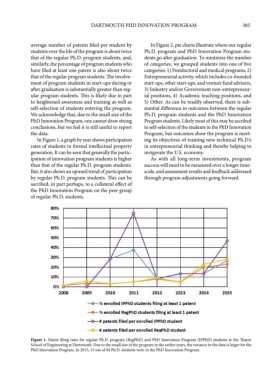
               In Figure 1, a graph by year shows participation   ing its objectives of training new technical Ph.D.’s
             rates of students in formal intellectual property   in entrepreneurial thinking and thereby helping to
             generation. It can be seen that generally the partic-  invigorate the U.S. economy.
             ipation of innovation program students is higher     As with all long-term investments, program
             than that of the regular Ph.D. program students.   success will need to be measured over a longer time-
             But, it also shows an upward trend of participation   scale, and assessment results and feedback addressed
             by regular Ph.D. program students. This can be   through program adjustments going forward.
             ascribed, in part perhaps, to a collateral effect of
             the PhD Innovation Program on the peer group
             of regular Ph.D. students.


             Figure 1. Patent filing rates for regular Ph.D. program (RegPhD) and PhD Innovation Program (IPPhD) students at the Thayer
             School of Engineering at Dartmouth. Due to the small size of the program in the earlier years, the variance in the data is larger for the
             PhD Innovation Program. In 2015, 15 out of 94 Ph.D. students were in the PhD Innovation Program.

