


Page 48 - Technology and Innovation Journal - 19-1
P. 48
386                                 FOSSUM ET AL.


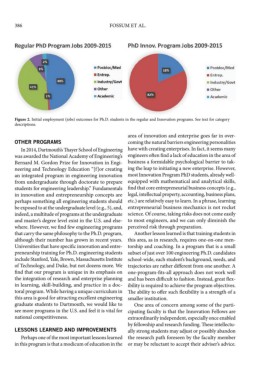
      Figure 2. Initial employment (jobs) outcomes for Ph.D. students in the regular and Innovation programs. See text for category
      descriptions.
                                                 area of innovation and enterprise goes far in over-
      OTHER PROGRAMS                             coming the natural barriers engineering personalities
        In 2014, Dartmouth’s Thayer School of Engineering  have with creating enterprises. In fact, it seems many
      was awarded the National Academy of Engineering’s  engineers often find a lack of education in the area of
      Bernard M. Gordon Prize for Innovation in Engi-  business a formidable psychological barrier to tak-
      neering and Technology Education “[f]or creating  ing the leap to initiating a new enterprise. However,
      an integrated program in engineering innovation  most Innovation Program PhD students, already well-
      from undergraduate through doctorate to prepare  equipped with mathematical and analytical skills,
      students for engineering leadership.” Fundamentals  find that core entrepreneurial business concepts (e.g.,
      in innovation and entrepreneurship concepts are  legal, intellectual property, accounting, business plans,
      perhaps something all engineering students should  etc.) are relatively easy to learn. In a phrase, learning
      be exposed to at the undergraduate level (e.g., 5), and,  entrepreneurial business mechanics is not rocket
      indeed, a multitude of programs at the undergraduate  science. Of course, taking risks does not come easily
      and master’s degree level exist in the U.S. and else-  to most engineers, and we can only diminish the
      where. However, we find few engineering programs  perceived risk through preparation.
      that carry the same philosophy to the Ph.D. program,    Another lesson learned is that training students in
      although their number has grown in recent years.  this area, as in research, requires one-on-one men-
      Universities that have specific innovation and entre-  torship and coaching. In a program that is a small
      preneurship training for Ph.D. engineering students  subset of just over 100 engineering Ph.D. candidates
      include Stanford, Yale, Brown, Massachusetts Institute  school-wide, each student’s background, needs, and
      of Technology, and Duke, but not dozens more. We  trajectories are rather different from one another. A
      find that our program is unique in its emphasis on  one-program-fits-all approach does not work well
      the integration of research and enterprise planning  and has been difficult to fashion. Instead, great flex-
      in learning, skill-building, and practice in a doc-  ibility is required to achieve the program objectives.
      toral program. While having a unique curriculum in  The ability to offer such flexibility is a strength of a
      this area is good for attracting excellent engineering  smaller institution.
      graduate students to Dartmouth, we would like to    One area of concern among some of the parti-
      see more programs in the U.S. and feel it is vital for  cipating faculty is that the Innovation Fellows are
      national competitiveness.                  extraordinarily independent, especially once enabled
                                                 by fellowship and research funding. These intellectu-
      LESSONS LEARNED AND IMPROVEMENTS           ally strong students may adjust or possibly abandon
        Perhaps one of the most important lessons learned  the research path foreseen by the faculty member
      in this program is that a modicum of education in the  or may be reluctant to accept their adviser’s advice.

