


Page 279 - MARSIUM'21 COMP OF PAPER
P. 279
quantitative  metrics  such  as  the  number  of  likes,  comments,  shares,  views,  or  followers  as  indicators  of  audiences'  engagement  level
            (Voorveld et al., 2018). The crucial elements in engagement, as stated by Schaefers et al. (2021), are its repetitive manner,  the incorporating
            resources (e.g., time and effort spent by consumers), and the interactivity happening among consumers within a particular channel (e.g.,
            amount and range of activities acted out on a social media platform) as it is fundamental to focus on consumers' engagement occurring by
            use of social media platform in a brand-related context.

            The behavior of ‘liking’ as engagement metrics imply consumer’s acceptance or satisfaction toward social media content (Moran et  al.,
            2020). Consumer comments when they have something to say in the social media community as a means to deliver their feelings or opinions
            in which other users can access and see (Song et al., 2021). Meanwhile, user’s activity of sharing will result in the spreading of information
            that perform as electronic word-of-mouth (eWOM) (Fu et al., 2017). Moreover, nowadays the features of ‘repost’ story in Instagram and
            ‘retweet’ another user’s tweet in Twitter also represent the metric of sharing. According to Muñoz-Expósito et al. (2017) regarding a metric
            used to evaluate engagement in Twitter, researcher noted that from a behavioral approach, users should be involved through interaction with
            the  content  to  stimulate  consumer  engagement  by  following  the  approach  provided  by  Kayser  and  Bierwisch  (2016)  of  five  main
            functionalities for users to interact on Twitter such as tweets, retweets, messages, hashtags, and follower relations.

            Recognizing the significance of social media in stimulating consumers’ engagement is essential since social media holds the power to help
            brands in evolving its users from passive consumers to active consumers in the forms of creating and sharing content with the other online
            users (Oh et al., 2016). The reason is that, marketers need to recognize types of consumers that have the tendency to actively engage with
            brands on social media platforms (Wallace et al., 2014) and their motivations to do so (Muntinga et al., as cited in Schivinski, 2021).

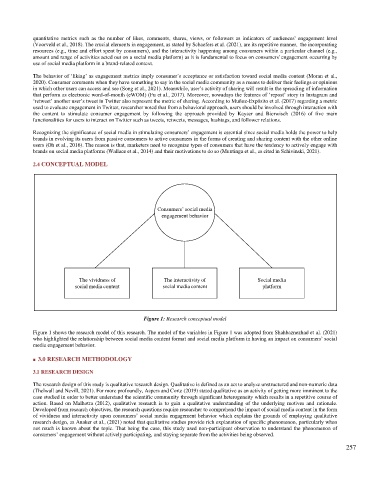
            2.4 CONCEPTUAL MODEL


                                                     Consumers’ social media
                                                       engagement behavior


                           The vividness of            The interactivity of           Social media
                          social media content         social media content             platform


                                                 Figure 1: Research conceptual model

            Figure 1 shows the research model of this research. The model of the variables in Figure 1 was adopted from Shahbaznezhad et al. (2021)
            who highlighted the relationship between social media content format and social media platform in having an impact on consumers’ social
            media engagement behavior.

            ■  3.0 RESEARCH METHODOLOGY

            3.1 RESEARCH DESIGN

            The research design of this study is qualitative research design. Qualitative is defined as an act to analyze unstructured and non-numeric data
            (Thelwall and Nevill, 2021). For more profoundly, Aspers and Corte (2019) stated qualitative as an activity of getting more imminent to the
            case studied in order to better understand the scientific community through significant heterogeneity which results in a repetitive course of
            action.  Based on Malhotra  (2012), qualitative  research  is  to gain  a  qualitative understanding  of  the  underlying  motives  and  rationale.
            Developed from research objectives, the research questions require researcher to comprehend the impact of social media content in the form
            of vividness and interactivity upon consumers’ social media engagement behavior which explains the grounds of employing qualitative
            research design, as Anaker et al., (2021) noted that qualitative studies provide rich explanation of specific phenomenon, particularly when
            not much is known about the topic. That being the case, this study used non-participant observation to understand the phenomenon of
            consumers’ engagement without actively participating, and staying separate from the activities being observed.

                                                                                                                    257

