


Page 282 - MARSIUM'21 COMP OF PAPER
P. 282
■4.0 FINDING
           ■4.0 FINDING

            4.1 DATA SCREENING

            This study presents an exploratory analysis of content format made by local skincare brands on Facebook, Instagram and Twitter. A total
            of 1,154 posts across three social media platforms from two skincare brands within three months were examined. The research methodologies
            adopted in this study are content analysis and statistical descriptive analysis.

            To ensure accuracy of the result of this study, data screening is needed. After identifying the unrelated and irrelevant data to be excluded in
                                                                             st
            the final sample, a total of 1,011 posts were gathered from 1  of October 2021 until 31  of December 2021. As mentioned previously,
                                                         st
            there were two types of posts; post(s) unrelated to skincare products and post(s) unrelated to the brand’s marketing purposes to be discounted
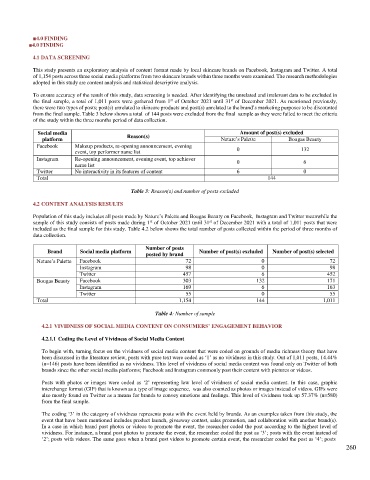
            from the final sample. Table 3 below shows a total  of 144 posts were excluded from the final  sample as they were failed to meet the criteria
            of the study within the three months period of data collection.

              Social media                                                      Amount of post(s) excluded
               platform                    Reason(s)                      Nature’s Palette      Bougas Beauty
             Facebook     Makeup products, re-opening announcement, evening
                          event, top performer name list                       0                     132
             Instagram    Re-opening announcement, evening event, top achiever   0                   6
                          name list
             Twitter      No interactivity in its features of content          6                     0
             Total                                                                        144

                                            Table 3: Reason(s) and number of posts excluded

            4.2 CONTENT ANALYSIS RESULTS

            Population of this study includes all posts made by Nature’s Palette and Bougas Beauty on Facebook,  Instagram and Twitter meanwhile the
                                                   st
            sample of this study consists of posts made during 1  of October 2021 until 31  of December 2021 with a total of 1,011 posts that were
                                                                      st
            included as the final sample for this study. Table 4.2 below shows the total number of posts collected within the period of three months of
            data collection.

                                                 Number of posts
                 Brand      Social media platform                  Number of post(s) excluded   Number of post(s) selected
                                                 posted by brand
             Nature’s Palette   Facebook                      72                        0                     72
                           Instagram                          98                        0                     98
                           Twitter                            457                       6                    452
             Bougas Beauty   Facebook                         303                     132                    171
                           Instagram                          169                       6                    163
                           Twitter                            55                        0                     55
             Total                                          1,154                     144                   1,011

                                                    Table 4: Number of sample

               4.2.1 VIVIDNESS OF SOCIAL MEDIA CONTENT ON CONSUMERS’ ENGAGEMENT BEHAVIOR

               4.2.1.1 Coding the Level of Vividness of Social Media Content

               To begin with, turning focus on the vividness of social media content that were coded on grounds of media richness theory that have
               been discussed in the literature review, posts with pure text were coded as ‘1’ as no vividness in this study. Out of 1,011 posts, 14.44%
               (n=146) posts have been identified as no vividness. This level of vividness of social media content was found only on Twitter of both
               brands since the other social media platforms; Facebook and Instagram commonly post their content with pictures or videos.

               Posts  with  photos  or  images  were  coded  as  ‘2’  representing  low  level  of  vividness  of  social media  content.  In  this  case,  graphic
               interchange format (GIF) that is known as a type of image sequence,  was also counted as photos or images instead of videos. GIFs were
               also mostly found on Twitter as a means for brands to convey emotions and feelings. This level of vividness took up 57.37% (n=580)
               from the final sample.

               The coding ‘3’ in the category of vividness represents posts with the event held by brands. As an examples taken from this study, the
               event that have been mentioned includes product launch, giveaway contest, sales promotion, and collaboration with another brand(s).
               In a case in which brand post photos or videos to promote the event, the researcher coded the post according to the highest level of
               vividness. For instance, a brand post photos to promote the event, the researcher coded the post as ‘3’; posts with the event instead of
               ‘2’; posts with videos. The same goes when a brand post videos to promote certain event, the researcher coded the post as ‘4’; posts
                                                                                                                    260

