


Page 377 - MARSIUM'21 COMP OF PAPER
P. 377
356                                        Leon (2021)

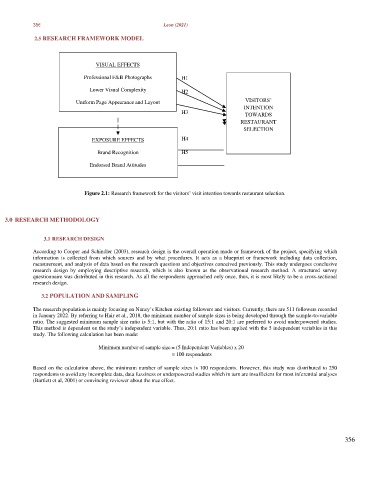
            2.5 RESEARCH FRAMEWORK MODEL


                                 VISUAL EFFECTS

                             Professional F&B Photographs    H1

                               Lower Visual Complexity       H2
                          Uniform Page Appearance and Layout                      VISITORS’
                                                                                  INTENTION
                                                             H3                   TOWARDS
                                                                                 RESTAURANT
                                                                                  SELECTION
                               EXPOSURE EFFECTS              H4

                                 Brand Recognition           H5

                               Endorsed Brand Attitudes


                             Figure 2.1: Research framework for the visitors’ visit intention towards restaurant selection.


    3.0  RESEARCH METHODOLOGY


               3.1 RESEARCH DESIGN

            According to Cooper and Schindler (2003), research design is the overall operation mode or framework of the project, specifying which
            information  is  collected  from  which  sources  and  by  what  procedures.  It  acts  as  a  blueprint  or  framework  including  data  collection,
            measurement, and analysis of data based on the research questions and objectives conceived previously. This study undergoes conclusive
            research  design  by  employing  descriptive  research,  which  is  also  known  as  the  observational  research  method.  A  structured  survey
            questionnaire was distributed in this research. As all the respondents approached only once, thus, it is most likely to be a cross-sectional
            research design.

               3.2 POPULATION AND SAMPLING

            The research population is mainly focusing on Nancy’s Kitchen existing followers and visitors. Currently, there are 511 followers recorded
            in January 2022. By referring to Hair et al., 2018, the minimum number of sample sizes is being developed through the sample-to-variable
            ratio. The suggested minimum sample size ratio is 5:1, but with the ratio of 15:1 and 20:1 are preferred to avoid underpowered studies.
            This method is dependent on the study’s independent variable. Thus, 20:1 ratio has been applied with the 5 independent variables in this
            study. The following calculation has been made:

                                  Minimum number of sample size = (5 Independent Variables) x 20
                                                          = 100 respondents

            Based on the calculation above, the minimum number of sample sizes is 100 respondents. However, this study was  distributed to 250
            respondents to avoid any incomplete data, data fuzziness or underpowered studies which in turn are insufficient for most inferential analyses
            (Bartlett et al, 2001) or convincing reviewer about the true effect.


                                                                                                                   356

