


Page 382 - MARSIUM'21 COMP OF PAPER
P. 382
361                                        Leon (2021)


            EBA3    I feel the restaurant is different from others.
            EBA4    How likely are you to revisit the restaurant?
            EBA5    How likely are you to recommend the restaurant to your friends?
            EBA6    How likely are you to be willing to share the restaurant photo or posts?
            VISIT INTENTIONS
            After browsing its Instagram profile, …
            VI1     I plan to visit Nancy’s Kitchen.                                                   0.812
            VI2     I truly want to visit Nancy’s Kitchen.
            VI3     I have higher intention of visiting Nancy's Kitchen compared to other restaurants.

            4.6 Validity Analysis

            To ensure that all the measurement items of the questionnaire are valid in this study, a validity test is required. Kaiser Mayer Olkin (KMO)
            Measure of Sampling Adequacy and Bartlett’s Test of Sphericity were implemented for validity analysis.  KMO is conducted to examine the
            strength of the partial correlation between the variables. The closer the KMO values, the more ideal for the data validation. If the KMO value
            is less than 0.50. From the result of Table 4.5, the KMO value is 0.804 (>0.50) representing a strong partial correlation among the variables.
            For Bartlett’s test of Sphericity, it is used to test the null hypothesis that the correlation matrix is an identity matrix. It is not an ideal factor
            of analysis if the correlation matrix is identity which means the variables are unrelated. The value of a significant statistical test from the
            study is 0.00 (<0.05) which shows that the correlation matrix is not an identity matrix (rejection of the null hypothesis).


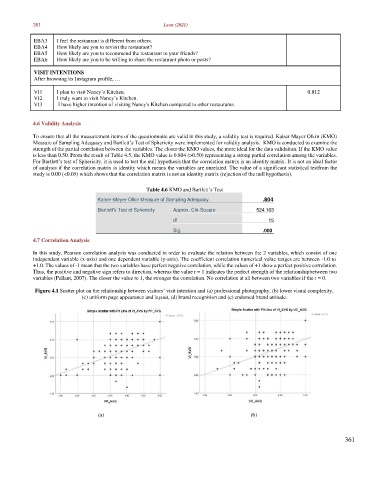
                                                 Table 4.6 KMO and Bartlett’s Test

                                 Kaiser-Meyer-Olkin Measure of Sampling Adequacy.       .804

                                 Bartlett's Test of Sphericity    Approx. Chi-Square     524.163
                                                            df                             15

                                                          Sig.                          .000
            4.7 Correlation Analysis

            In this study, Pearson correlation analysis was conducted in order to evaluate the relation between the 2 variables, which consist of one
            independent variable (x-axis) and one dependent variable (y-axis). The coefficient correlation numerical value ranges are between -1.0 to
            +1.0. The values of -1 mean that the two variables have perfect negative correlation, while the values of +1 show a perfect positive correlation.
            Thus, the positive and negative sign refers to direction, whereas the value r = 1 indicates the perfect strength of the relationship between two
            variables (Pallant, 2007). The closer the value to 1, the stronger the correlation. No correlation at all between two variables if the r = 0.

             Figure 4.1 Scatter plot on the relationship between visitors’ visit intention and (a) professional photography, (b) lower visual complexity,
                            (c) uniform page appearance and layout, (d) brand recognition and (e) endorsed brand attitude.


                                  (a)                                               (b)


                                                                                                                   361

