


Page 378 - MARSIUM'21 COMP OF PAPER
P. 378
357                                        Leon (2021)

              3.3 DATA COLLECTION

            The questionnaire will be distributed to the respondents by using systematic sampling for Instagram followers whereas convenience sampling
            for its visitors. For systematic sampling, the samples are selected by selecting a random starting point, and then continuously selecting each
            ith element from the sampling frame. (Note: ith is the sampling interval, is being determined by dividing the population size, N by the sample
            size, n and rounding to the nearest integer). In this study, there are 511 elements in the population and a sample of 170 is desired. A random
            number between 1 and 250 is selected. If, for example, this number is 1, all the samples consist of elements 1, 11, 12, 13, 14, 15, and so
            on. 250 questionnaires will be distributed among followers of Instagram in Nancy's kitchen through private chat by online Google Forms.
            Nevertheless, due to the low return of feedback, another approach is being carried out which is a convenient approach, asking the visitor who
            comes on-site to fill in the survey form.

              3.4 RESEARCH INSTRUMENT

            The use of a quantitative approach was considered most suitable for this study. The questionnaire can be divided into two main parts. Part
            A consists of 9 questions asking for respondents’ demographic profile. Part B consists of 33 questions mainly to answer the independent
            variables (IV) and dependent variables (DV). There are 18 questions on visual effects, 12 questions on exposure effects and 3 questions from
            visitors’ intention towards restaurant selection. The set of questionnaires are asking the respondents to tick from the given selection. Five
            points Likert scale is to determine the strength of the answer with levels of agreement such as ‘1 = strongly disagree’, ‘2 = disagree’, ‘3 =
            neutral’, ‘4 = agree’, and ‘5 = strongly agree’.


              3.5 DATA ANALYSIS PLAN

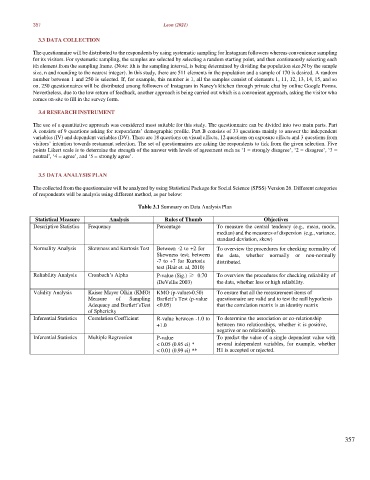
            The collected from the questionnaire will be analyzed by using Statistical Package for Social Science (SPSS) Version 26. Different categories
            of respondents will be analysis using different method, as per below:

                                               Table 3.1 Summary on Data Analysis Plan

             Statistical Measure     Analysis           Rules of Thumb                  Objectives
            Descriptive Statistics   Frequency       Percentage          To  measure  the  central  tendency  (e.g.,  mean,  mode,
                                                                         median) and the measures of dispersion (e.g., variance,
                                                                         standard deviation, skew)
            Normality Analysis   Skewness and Kurtosis Test   Between -2 to +2 for   To overview the procedures for checking normality of
                                                     Skewness  test;  between   the  data,  whether  normally  or  non-normally
                                                     -7 to +7  for  Kurtosis   distributed.
                                                     test (Hair et. al, 2010)
            Reliability Analysis   Cronbach’s Alpha   P-value (Sig.) ≥  0.70   To overview the procedures for checking reliability of
                                                     (DeVellis 2003)     the data, whether less or high reliability.
            Validity Analysis   Kaiser Mayer Olkin (KMO)  KMO (p-value>0.50)   To ensure that all the measurement items of
                              Measure   of   Sampling  Bartlett’s Test (p-value   questionnaire are valid and to test the null hypothesis
                              Adequacy and Bartlett’s Test  <0.05)       that the correlation matrix is an identity matrix
                              of Sphericity
            Inferential Statistics   Correlation Coefficient   R-value between -1.0 to  To determine the association or co-relationship
                                                     +1.0                between two relationships, whether it is positive,
                                                                         negative or no relationship.
            Inferential Statistics   Multiple Regression   P-value       To predict the value of a single dependent value with
                                                     < 0.05 (0.95 ci) *   several  independent  variables,  for  example,  whether
                                                     < 0.01 (0.99 ci) **   H1 is accepted or rejected.


                                                                                                                   357

