


Page 461 - MARSIUM'21 COMP OF PAPER
P. 461
Muhamad Rifqi Zafran Bin Abdul Hakim (2022)
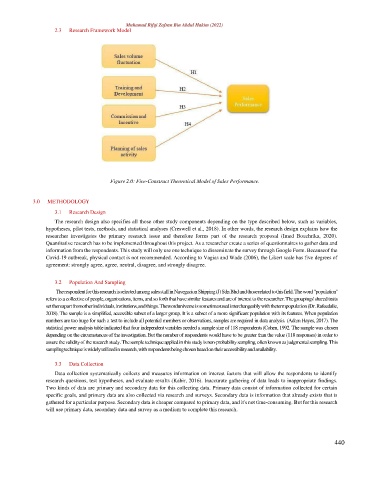
                   2.3   Research Framework Model


                                      Figure 2.0: Five-Construct Theoretical Model of Sales Performance.


            3.0   METHODOLOGY
                   3.1   Research Design
                   The research design also specifies all those other study components depending on the type described below, such as variables,
                hypotheses, pilot tests, methods, and statistical analyses (Creswell et al., 2018). In other words, the research design explains how the
                researcher  investigates  the  primary  research  issue  and  therefore  forms  part  of  the  research  proposal  (Imed  Bouchrika,  2020).
                Quantitative research has to be implemented throughout this project. As a researcher create a series of questionnaires to gather data and
                information from the respondents. This study will only use one technique to disseminate the survey through Google Form. Because of the
                Covid-19 outbreak, physical contact is not recommended. According to Vagias and Wade (2006), the Likert scale has five degrees of
                agreement: strongly agree, agree, neutral, disagree, and strongly disagree.

                   3.2   Population And Sampling
                    The respondent for this research is selected among sales staff in Navegacion Shipping (J) Sdn Bhd and those related to this field. The word "population"
                refers to a collective of people, organizations, items, and so forth that have similar features and are of interest to the researcher. The groupings' shared traits
                set themapart fromother individuals, institutions, and things. Theworduniverse is sometimesused interchangeably with thetermpopulation (Dr. Rafeedalie,
                2018). The sample is a simplified, accessible subset of a larger group. It is a subset of a more significant population with its features. When population
                numbers are too huge for such a test to include all potential members or observations, samples are required in data analysis. (Adam Hayes, 2017). The
                statistical power analysis table indicated that four independent variables needed a sample size of 118 respondents (Cohen, 1992. The sample was chosen
                depending on the circumstances of the investigation. But the number of respondents would have to be greater than the value (118 responses) in order to
                assure the validity of the research study. The sample technique applied in this study is non-probability sampling, often known as judgmental sampling. This
                sampling technique is widely utilized in research, with respondents being chosen based on their accessibility and availability.

                   3.3   Data Collection
                   Data collection systematically collects and measures information on interest factors that will allow the respondents to identify
                research questions, test hypotheses, and evaluate results (Kabir, 2016). Inaccurate gathering of data leads to inappropriate findings.
                Two kinds of data are primary and secondary data for this collecting data. Primary data consist of information collected for certain
                specific goals, and primary data are also collected via research and surveys. Secondary data is information that already exists that is
                gathered for a particular purpose. Secondary data is cheaper compared to primary data, and it's not time-consuming. But for this research
                will use primary data, secondary data and survey as a medium to complete this research.


                                                                                                                440

